
Almost like an orchestrated plan to scare the unwilling into submission, daily headlines scream about the coming "Tidal Wave of Alzheimer's Cases."1 Indeed, reported incidences of this difficult to diagnose malady seem to increase daily -- and are expected to reach nearly nine million strong in the United States by the year 2020.2
But the rest of the story is that much needed hearing health care, along with its powerful cognitive, communicative and psychosocial implications, is virtually being ignored within the mental health/medical diagnostic battery.3 A growing number of studies reveal a strong correlation between unmitigated hearing loss and dementia in older adults.4,5,6
The primary trends in the outward signals of advancing dementia are not so much an increase in actual pathology, but a demographic reflection of the rapid increase of those living longer than generations before them. Furthermore, Alzheimer's patients appear to be exhibiting far more serious hearing loss, yet are not routinely referred for aural rehabilitation -- as they should be.7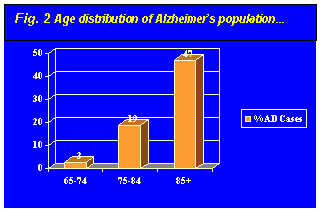
Figure 1 shows there will soon be a virtual groundswell of those living past 65 years of age in the United States, where the vast majority of dementia cases occur.8,9 These patients will constitute most of the so-called "tidal wave". Here the largest demographic advance is in the 85 years and older group. We also note that the growth of both of these age groups (over-65, over-85) correlates strongly with the increased incidence of Alzheimer's disease (AD) and serious hearing loss as shown in figures 2 and 3, revealing an undeniable statistical parallel. 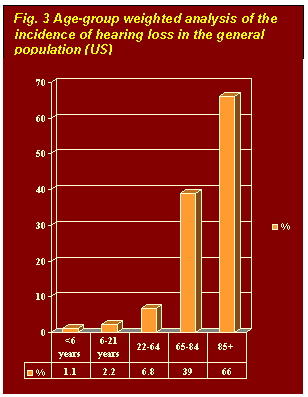
Accordingly, in comparing symptoms of AD and unmitigated hearing loss in Figure 4 (below), we find a striking correlation; one that should make thinking persons sit up and take notice!
Unfortunately, there is an alarmingly low hearing aid penetration rate among the 28-million strong hearing impaired population in the U.S.A. Since 1992, this trend has continued downward (or flat) as compared to the rapidly growing expanse of those needing hearing help, but are not seeking it. 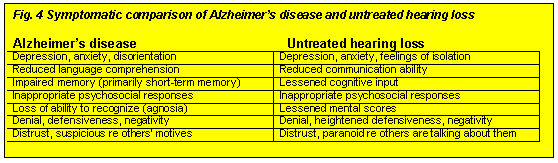
Field reports show that too few older patients who present with complaints of possible AD are tested and treated for hearing loss. Many of these patients have been told they were not candidates for hearing aids -- without so much as a basic hearing test; others have been advised to seek hearing amplification "on a trial basis".
30 day trials: A dis-service to patients, and in particular - the AD patient!
Research indicates that most hearing aid patients need 90-120 days for neurological and physical acclimatization to hearing aid amplification.16,17 Certainly for the patient with dementia overlay, an expectation of perhaps 6-12 months to achieve appreciable goals of enhanced quality of life and personal independence through amplification.15
As a result of 30-day trial policies, and the concomitant expectation that hearing aid patients should have all of their amplification issues solved in this time period, the hearing aid industry (and related legislation) has created an entire generation of hearing impaired non-users who think "hearing aids don't work", because they couldn't achieve their desired outcomes in the impossibly brief space of 30 days. This common "30 day out" fitting philosophy places reasonable business expectations at odds with speedy, unreasonable rehabilitative expectations, causing far too many forfeited hearing products and services.
Personal Anecdotal Example:
Over the years the author has had the opportunity to visit numerous long-term nursing facilities. Invariably, the question has been asked, "How many of your patients suffer from dementia?" Almost without variation the answer comes back, "Well, MOST of them, actually. That's why they're here."
In follow-up, I ask, "How many suffer from serious hearing loss?", to which the reply would be, "Well, let's see, Mr. Jones has a hearing aid, and Mrs. Smith has two...that's all I can think of...the rest of our residents hear fine."
However, hearing screening tests administered to the entire residential population finds that every resident there suffered from a bilateral loss greater than 30dB PTA (mild hearing loss) with many in excess of 65dB PTA (moderate hearing loss).
And, oh yes, regarding the two patients who already have hearing aids ... Mr. Jones' hearing aid was lost in the wash 6 months ago, and Mrs. Smith's aids were plugged solid with cerumen (ear wax) each sporting a dead, crusted-over zinc-air battery requiring a pocket knife to remove.
Evaluation and Rehabilitation Models:
Therefore, we must develop and implement better evaluation and rehabilitation models in hearing healthcare for those who suffer from dementia. An appropriate model would include educational materials geared towards hearing loss and the signs, symptoms and profiles of patients with hearing loss, in combination with other diagnosis, such as Alzheimer's disease. Distribution of these materials among allied professionals appears paramount to addressing the needs of previously undiagnosed hearing impaired patients. Further, doing so will effectively bring several other professionals into the circle of care: occupational therapists, psychologists, physical therapists, geriatricians, and eldercare professionals.17
The lack of an effective evaluation and rehabilitation model may explain why the most medically and clinically intensive portion of the older adult population—those reporting AD complaints---shows a dismal 10% hearing aid usage rate (of those needing hearing correction), compared to 60% hearing aid usage rate among the hearing impaired non-AD population. 10 (Across the general population of the USA, the percentage of hearing impaired people who wear hearing aids is between approximately 20 to 25 percent.)
Yet the percentage of need for hearing aids among those with AD runs somewhere between 90-100%. For example, of 52 elderly patients diagnosed with memory disorders in a University of South Florida 1996 study, 49 were found to suffer from serious uncorrected hearing impairment.11
For the AD population, there is persuasive evidence that hearing aid use combined with proper aural rehabilitation (in a multidisciplinary setting) can be a cost-effective approach in alleviating many AD-identified symptoms, in patients who have AD and hearing loss.12,13,14 In this case, such a program has been found to lessen many debilitating symptoms including; depression, passivity, negativism, disorientation, anxiety, social isolation, feelings of helplessness, loss of independence, and general cognitive decline.11
Removing barriers to hearing healthcare:
A research team out of the University of Pittsburgh, in their composite review of studies on the subject of AD and hearing loss, concluded there existed several professional and institutional barriers that prevent AD patients who suffer from hearing loss from receiving the hearing health care they need:11
Identified Barriers:
Each of these barriers can be overcome with intensified educational programs across all healthcare disciplines, with emphasis on the front lines, especially with primary care physicians. Medical, professional and clinical programs should include principles of the interrelationship between cognition and aural rehabilitation. Mental health professionals and researchers (including pharmacology trials) should require hearing evaluations as part of the early diagnostic battery. Also, current pharmaceutical clinical trials under "crash-program" (i.e., fast track) status should include hearing evaluations and management in their protocols or risk losing objectivity in clinical outcomes. In essence, no diagnosis of AD should be rendered without ascertaining auditory status.
Obtaining comprehensive audiometric evaluations and executing auditory rehabilitation management protocols may include both hearing instrument specialistsand audiologists. Hearing instrument dispensing programs should include comprehensive, multidisciplinary approaches to effective aural rehabilitation (AR). These AR programs should feature; coping and communication repair strategies, assistive devices, cochlear implantation issues, individual or group AR sessions (preferably with loved-ones present) in-depth patient education, hearing aid use and orientation, hearing aid maintenance, counseling regarding the Americans with Disabilities Act (ADA) of 1990, and other topics. This will help raise the quality of life for all hearing impaired patients, especially those with AD overlay who are in danger of losing their ability to be part of the larger society.
Conclusion :
The literature is replete with conclusive evidence that unmitigated hearing loss increases depression, hypertension, heart conditions, dementias, long-term convalescence, income loss, and the breaking of familial bonds. Yet far too many of those needing hearing care, to assist in the prevention and/or amelioration of accompanying dementia, are not receiving it.
A steady, coordinated drumbeat of professional and consumer education can significantly pierce through the wall of public, professional, and governmental misconceptions.
Obviously, the distance between informed mental/hearing health management and today's current standards of care appears to be great. Closing the gap will require ongoing research and education, motivational marketing and an unyielding commitment by all healthcare professionals, and family members of the patients. Hopefully, these changes will occur in time to help stem the anticipated "tidal wave" of Alzheimer's.
 About the author...
Dr. Chartrand serves as director of research for DigiCare® Hearing Research & Rehabilitation, and is a faculty member of the International Institute for Hearing Instruments Studies and the American Conference of Audioprosthology. Fax correspondence: 719-676-6882 or email to chartrandmax@aol.com.
References
1. USA Today, "The Coming Tidal Wave of Alzheimer's", March 22, 2000. 2. Aural Rehab Concepts, A survey of the literature on the prevalence of Alzheimer's, Rye, CO, 2000. 3. Chartrand, M.S., Alzheimer's & Hearing Loss, a professional education course, International Institute for Hearing Instruments Studies, Livonia, MI, 2000. 4. Ulmann, R., Larson, E., Rees, T., Koepsell, T., Duckert, L., "Relationship of hearing impairment to dementia and cognitive function in older adults," JAMA, 261:1916-1919, 1989. 5. Peters, C., Potter, J., and Scholer, S., "Hearing impairment as a predictor of cognitive decline in dementia," J Am Geriatric Soc, 36:981-986, 1988. 6. Ventry, I., and Weinstein, B., "The hearing handicap for the elderly: a new tool," Ear & Hearing, 3:128-133, 1982. 7. Chartrand, M.S., "Demographics in Hearing Healthcare," a continuing education course, International Institute for Hearing Instruments Studies, Livonia, MI, 1999.
8. U. S. Bureau of the Census Report, 1998. 9. Aural Rehab Concepts, Statistical Projection for Alzheimer's in the U.S. Population 2000-2020, Rye, CO, 2001. 10. Palmer, C., Adams, S., Durrant, J., Bourgeouis, M., and Ross, M., "Managing Hearing Loss in Patient with Alzheimer Disease," J Am Acad Audiol, 9:275-284, 1998. 11. Gold, M., "Hearing Loss in a Memory Disorders Clinic: A Specially Vulnerable Population," Archives of Neurology, 53:922, 1996. 12. Durrant, J., Gilmartin, J., Holland, A., Kamerer, D., Newall, P., "Hearing disorders management in Alzheimer's disease patients," Hear Instrum 42:32-35, 1990. 13. Hardick. E. , "Aural rehabilitation programs for the aged can be successful," J Acad Rehab Audiol, 10:51-67, 1977. 14. Ratcliffe, D., (Citation) Task Force on the National Strategic Research Plan of the National Institute on Deafness and Other Communication Disorders: "Costs, benefits, and quality of life," H Journ, 45(9):11-18, 1992. 15. Gatehouse, S, and Killion, M., "H.A.B.R.A.T.: Hearing Aid Brain Rewiring Accommodation Time", Hear Instrum, 44(10):29-32, 1993. 16. Palmer, C., "Deprivation, Acclimatization, Adaption: What Do They Mean For Your Hearing Aid Fittings?", Hear J, 47(5):10, 41-45, 1995. 17. Chartrand, M., and Chartrand, G., "Sherlock & Watson on solving the mysteries of aural rehabilitation," a continuing education course, International Institute for Hearing Instruments Studies, Livonia, MI, 2001.