Klamath Falls, OR
[email protected]
I started college in 1980 after finishing a tour of duty with Uncle Sam. I lived in Port Angeles, WA, and enrolled at Peninsula College. By 1987, I completed my master's degree in audiology at Western Washington University and found myself at a crossroads. I wanted to pursue a Ph.D. I had previously funded my education by working full-time and used my educational benefits from the GI Bill. My GI Bill benefits were exhausted. I also started a family. My son, Robby was six and my daughter, Ashley, was nearly two years old when I contemplated a doctorate. I believed then, as I do now, that I wanted a significant role in their lives. I was tired of working and going to school full-time. I had no free time. I elected to enter professional life and did not pursue a Ph.D. Within a year, I started my private practice.
1989 was a pivotal year for audiology. The AFA was created and charged to "transform audiology to a doctoral profession with the Au.D as its distinctive designator." Audiologists began their first significant step towards professional unification with the adoption of the Au.D. As the 1990's ended, I noticed more and more audiologists with Au.D degrees. It was increasingly difficult to pick up an audiology journal, or review www.audiologyonline.com, and find an audiologist with solely a master's degree. Most audiologists seemed to have their doctorates. The Au.D. movement was in full throttle and I was out of the loop! Distance education was tenable, viable, and available to practicing audiologists.
In 2001, I began visiting with audiologists about the Au.D. I was amazed at the reasons they offered for not participating in distance education. All the arguments I heard were full of holes, and had little to do with reality. Some of the common themes included:
- The Au.D. degree was perceived by some as a "mail order degree."
- Universities "can't teach me anything about my profession that I don't already know."
- Earning the Au.D. degree will "ruin my business and family life" due to time and money constraints.
- I won't earn more money as a result of the Au.D. degree.
- Other members of the health care team won't treat me with "doctoral" respect.
Selecting a School
Choosing a distance education program was complicated. The biggest obstacle was that I couldn't physically travel to visit the schools. My professional and personal responsibilities were vast, and I had little time to spare. I was surprised at how difficult it was to gather information about the four programs. The four programs I investigated, the people I worked with, and their e-mail addresses included:
- Arizona School Of Health Sciences
Dr. Tabitha Parent-Buck
[email protected]
www.ashs.edu/discpl_au.htm - Central Michigan University
Kendra Brown
[email protected]
www.cel.cmich.edu/aud/ - PCO School Of Audiology
Dr. George Osborne
[email protected]
www.audonline.org - University Of Florida
Joy Colle
[email protected]
www.audiology.ufl.edu
As I researched the four schools (above), two other informative websites were www.audfound.org/index.cfm?pageID=19 and www.audiologist.org/prof_distance_ed.php.
My initial research involved using email contacts from the university's web pages. Unfortunately email was not always successful, as I did not always get a response. However, by returning to the websites, I found phone numbers that were very helpful. I used the phone numbers to contact the universities for names, email address, and phone numbers of recent graduates. I interviewed the graduates on my own. I received four names and phone numbers from ASHS, and each graduate was positive about their experience and their degree.
In many ways, I was shopping for the school that would do the best job for me and meet my individual needs. The two non-negotiable points that I had to consider were:
- I would not and could not leave my practice for long periods, and did not want to travel long distances.
- I did not want to take classes in areas where I already felt confident of my abilities. I eliminated programs that did not take into account my work experience.
The two programs that best fit my needs were the Arizona School of Health Sciences and Pennsylvania College of Optometry.
The Application Process
Before applying to either school, I had to complete the Evaluation of Practicing Audiologists Capabilities (EPAC). The EPAC was designed as an objective tool for evaluating the skills and knowledge of practicing audiologists. For more information about the EPAC visit: www.audfound.org. Probably the most difficult part of the EPAC was documenting all continuing education hours since graduate school. It took me weeks to reconstruct my professional education history since completing my master's program.
I submitted my application to the Arizona School of Health Sciences in early December, and had my interview in February 2003. During the interview, my advisor informed me of the core requirements needed to complete the program. She also suggested electives to round out my program. I was able to negotiate the electives so we were both happy! I enrolled.
Applicants considering the Arizona program should know that the maximum credit load is 24 credits. Arizona offers over 40 credits for distance education. While you may elect to take more than your core requirements, your total credits cannot exceed 24. I completed the program in June 2004. The knowledge gained, the doctoral experience. and the benefit to me as a person and a professional, was simply enormous.
My Au.D. Program Highlights
During the program I had the opportunity to get involved with different aspects of my profession. Among the many accomplishments achieved throughout my program, the following were some of the more significant:
- The development of a policy and procedure manual which allowed me to better understand the role of HIPAA and CMS and their interaction with my office. I also established and formalized an Employee Policies and Procedures protocol. This allowed me to become a better manager of my employees.
- The creation of APD 1.0 which was accomplished during the Central Auditory Processing Disorders (CAPD) class. I created a software learning tool for parents and professionals to aid them in understanding the diagnosis and treatment of CAPD ( www.hearingoffice.com/badown.htm).
- The development of a vestibular questionnaire. The vestibular assessment class allowed me to create a questionnaire that I use when interviewing patients with respect to their balance problems. Future version of the Hearing Office Pro will include the questionnaire as well.
- The pharmacology class reaffirmed my commitment to the role of the audiologist in ototoxic monitoring. The class brought new awareness of how medications affect hearing and balance. I created a checklist for my office that is used during the patient intake process.
- The cochlear implant class allowed me to revisit eligibility requirements and technological changes since my externship at the VA in the mid 1980's. They have changed dramatically!
- Receiving the AFA Leadership award. I was honored to receive this award in Arizona the day before graduation. Three graduates received the AFA Professional Leadership Awards based on faculty recommendations.
- I had an opportunity to work on an endowment fund, ASHS Au.D Endowment, which will be used for scholarships to 2nd year resident students attending ASHS. This was the gift from my graduating class to ASHS.
Work and Time Issues:
When I enrolled, I did not understand the vast amount of work and time required to complete my program. I did not take time off between courses, as I wanted to push through as quickly as possible. I found it very difficult to work at my normal pace while applying myself in the evenings to the required studying. I began my program in March 2003, and by October I was in serious trouble. I was very fatigued. I was amazed to learn that some of my colleagues were capable of doubling up on classes!
During the time I was in the program, I was tested at least every two weeks, and many classes required weekly paper submissions. Almost all classes required at least one night each week for an online chat. On average, I spent 10-20 hours per week studying.
If you are considering distance education programs, you should carefully evaluate your work requirements. Here are a few ways to reduce the stress:
- Take breaks between classes and don't try to go through non-stop. You may need to take a month or two between classes.
- If you normally take a family vacation, take it and schedule your Au.D program around it.
- Consider hiring an associate BEFORE you begin.
- Don't double-up on classes.
Epilogue
Early in my program, Dr Ruggle wrote an inspirational note to his students. He said because of this experience, I would think and practice on a higher level and the Au.D program would change my life! Well, Dr Ruggle was right!
The critics who told me the Au.D would not be worthwhile were wrong! Without exception, my clinical practice benefited from the Au.D experience. I learned more than I could have imagined, and took away something positive from each class.
Becky White (from the AFA) recently supplied statistics from the four distant education programs. The following chart reviews the numbers...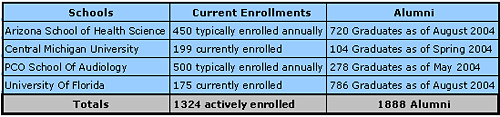
To date, there are over 3200 audiologists that have earned or are currently enrolled in Au.D. programs. As audiology moves forward, we will continue to be successful in establishing our role as leaders in hearing health care. The Au.D is our first step in changing our role and redefining audiology in healthcare. By better defining our professional role in hearing health care, by using a doctoral approach to our clinical and professional knowledge, and by always placing the patient first, we have redefined the profession.