
One of the first questions new hearing aid wearers ask is "How long will my batteries last." Of course, the answer is somewhat complex. To estimate battery life, a simple equation is used.
Battery life (hours) = battery mAh rating/battery current.
Unfortunately, even for those well versed in math, that number is at best, an estimate. Battery life is affected by a number of variables including battery mAh and hearing aid factors such as; gain control, signal intensity, sound input, and discharge voltage level, additionally, one must consider temperature and humidity, dry-aid kit usage, and other environmental factors too.
This article will address battery service life and related issues.
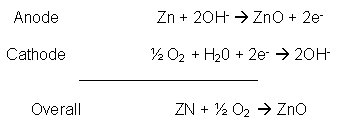
The first factor affecting battery service life is mAh rating. The battery chemistry most commonly used in hearing aid batteries is zinc-air. Through a unique design that uses zinc and oxygen as their negative and positive electrodes, respectively, these batteries maximize mAh output. The chemical reaction required to power an aid occurs when zinc is oxidized by hydroxyl ions, liberating water and electrons. The water then migrates by osmosis to the cathode while electrons collect on the negative terminal (zinc). Electrons flow to the cathode through some resistive load, doing work (generating a current) over time. Oxygen from the outside air diffuses into the cell though small vent holes as needed. Oxygen is reduced in the presence of electrons, consuming water and electrons, and producing hydroxyl ions, which carry the electron to the anode for zinc oxidation. These reactions are summarized below:
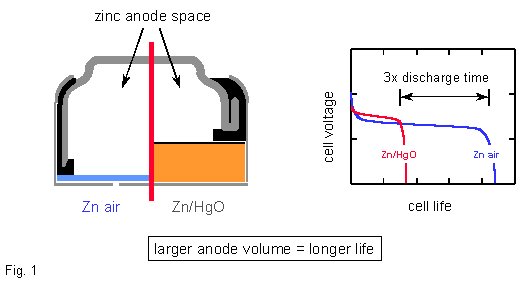
Zinc-air has replaced mercury systems previouly used in hearing aid batteries because of their higher energy density. This is illustrated in figure 1 which compares the anode compartment volumes. The very thin cathode of the zinc-air cell allows the use of up to three times more zinc than could be used in the mercury equivalent. However, mAh ratings vary between manufacturers. To provide your patients the best service life, check to be sure you're getting the highest rating available.
Next, you need to look at a number of other factors that affect battery service life; gain control, signal intensity, and sound input. Case study No.1 illustrates the effect of these factors.
CASE STUDY ONE:
Jane has a binaural, sensorineural, moderate hearing loss. She is 61 and a recent widow, living alone. Other then tinkering in her garden and visiting her grandchildren, she leads a quiet lifestyle. She was fitted binaurally with Digital Aid X.
To determine Jane's battery life, the audiologist used the formula illustrated above, the zinc-air battery's mAh rating divided by the hearing aid battery current.
Battery mAh rating (290 mAh) / battery current (1.1 ma) = Battery Life (264 hours)
ALIGN='CENTER'>To determine "days of use" the audiologist used the 264-hour estimate and divided by the approximate hours of use per day, in Jane's case 16 hours. If these are the only factors affecting battery life, Jane should expect to change her battery every 16 -17 days.
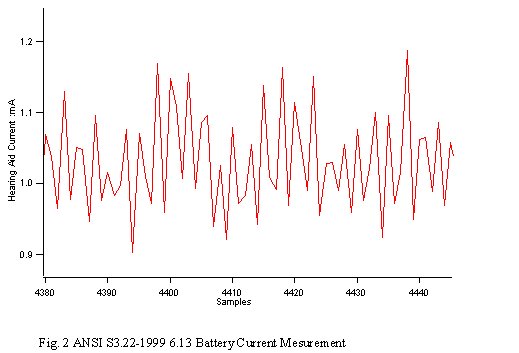
Unfortunately, there are more factors to consider. First, the battery current is derived from a method specified by the American National Standards Institution (ANSI S3.22-1996). The battery current is measured with the gain control in the reference test position, using a pure-tone, 1000-Hz input signal at a SPL of 65dB.
Fig. 2 is a real time measurement of Jane's Digital X aid. Note that in a real time measurement the battery current varies between .9 ma and 1.2 ma. It is the average of this varying battery current, 1.1 ma, that is reported on the hearing aid specification sheet.
The amount of gain and therefore current depends on where the volume control and all the filter controls are set. As gain increases, current increases, which further decreases service life. Jane's gain volume control was set nearer to full-on, which is higher then the ANSI reference test position. This test run again with the volume set at full-on will result in a battery current of 1.5 ma. Using a battery current of 1.5 ma in our earlier calculation would reduce Jane's battery service life estimate to 12 days.
Another factor to consider is the patient's lifestyle. As figure 3 demonstrates, Jane's Digital X aid experiences an increase in current as the 1000 hz signal intensity and the volume control increases.
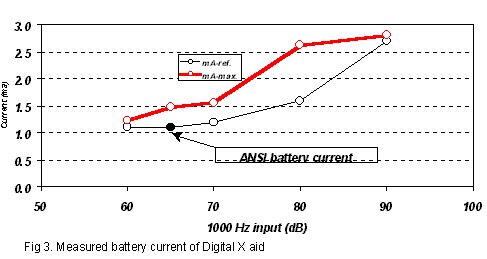
Since Jane leads a quiet lifestyle our previous estimate of 12 days would not change. If her lifestyle changes, for instance, if she would start working in a restaurant where she would experience longer durations of more intense ambient noise she might expect to experience shorter battery service life.
So far we have only analyzed the effect of pure tones on hearing aid current drains. Another issue to consider is the effect of broadband sounds in deriving meaningful battery life measurements, given nonlinear aids. If the hearing aid is operating linearly, measurement with pure tones will give exactly the same gain-frequency response as measurement with broadband noise, no matter what the spectral shape of the broadband signal. However, many aids do not simply amplify linearly over a wide range of input levels. In many aids, the most common cause of nonlinearity is compression, which involves an amplifier whose gain depends on the input signal. If we imagine a more complex hearing aid, such as a three-channel compression aid, the gain-frequency response measured will also depend on the shape of the input spectrum. The most realistic assessment of the effect of the hearing aid on speech will occur when the input spectrum has a spectrum similar to that of speech. Some hearing aid circuits attempt to distinguish speech from background noise and alter their amplification characteristics according to how much they detect in each frequency region. Such circuits may treat swept pure tone and stationary noise test signals as though they were background noise and decrease their amplification (2001, Dillon).
A number of noise test signals have been developed to deal with this issue. We have chosen to use ICRA noise signals (ver. 0.3) to study the effects of speech like signals and their effect on battery performance in the hearing aid. Ten tracks of these noise signals are encoded on a CD that can easily be set to perform real-time measurements of currents and voltage in a hearing aid. Fig. 4 is a real time measurement of battery current and voltage in Jane's hearing aid using a 65 dB unmodulated, random Gaussian noise signal.
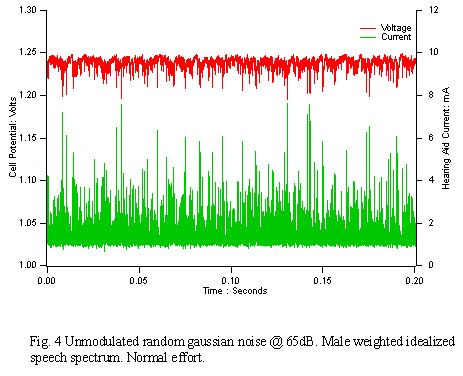
While the ANSI battery current measurement is an average reading it can be seen though this measurement that the hearing aid is never in a steady state condition. As a signal inputted into the aid varies in intensity, the hearing aid current either increases or decreases in response. The battery voltage will also fluctuate as a direct result of these current changes. The average current measured was 1.51 ma (fig. 5b) and the average voltage was 1.239(fig 5a). If we analyze the current and voltage distributions the current can go as high as 7.6 ma and voltage as low as 1.195. Ten percent of the time Jane's aid has currents as high as 2.28 ma. With due consideration for these variables, Jane can still experience about 12 days of service life.

The final factor to consider is battery discharge voltage level. This is the average voltage level that the hearing aid battery discharges as related to the hearing aid output. Suppose Jane's aid was set to output 115db when a 70.7 db unmodulated random guassian noise signal was inputed, as the aid's output increases, the overall voltage of the battery will decrease and voltage variability will increase.
This issue of discharge voltage level will influence battery life when fitting a profoundly deaf patient with a high output power aid.
CASE STUDY TWO:
Case study No.2 is of Jimmy, a young child who has a profound, sloping loss. He is fitted with an analog programmable power aid, using a size-13 battery. The aid is set to full-on gain.
First let's compare the voltage and current levels of Jimmy's aid to Jane's aid using a 70.7 dB unmodulated random qaussian noise signal input (fig. 6). Jimmy's aid outputted 125 dB which was 10db higher than Jane's aid. Powering Jimmy's output requires more current than a typical hearing aid. The average current measured was 2.6 ma, which was 0.9 ma higher then Jane's aid. Jimmy's average voltage was .071 volts lower than Jane's aid.
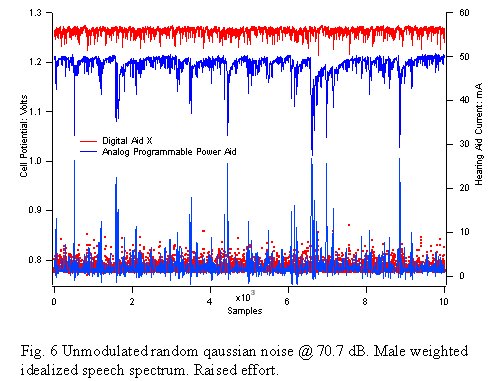
When the battery voltage runs at levels approaching 1.1v, there is concern over the hearing aid "endpoint." The hearing aid endpoint is the voltage level at which the hearing aid doesn't properly function. A typical analog aid, like Jimmy's, will see a gradual loss of gain as the battery voltage falls from 1.1 volts to 0.9 volts. Digital aids can abruptly stop working at about a 1.1 volt battery endpoint.
Fig. 7 graphs the real time voltage distribution when Jimmy's aid reacted to unmodulated random gaussian noise at 70.7db input.
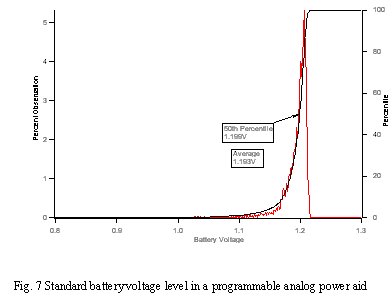
The battery voltage fell below 1.1 volts 1.2% of the time which will produce low sound output in Jimmy's aid.
To resolve this issue, battery manufacturers have offered high-power batteries. The high-power battery is designed to run at a higher voltage in a power aid.
Fig. 8 looks at the Rayovac High-Power battery voltage distribution under the same input conditions described above. The high-power battery is able to maintain above 1.1 volts even during high current pulses. Using the same sound inputs as the standard battery above, the average voltage for the high-power battery is 1.26 volts with the lowest point at 1.13. The "high power" battery eliminates the low sound output Jimmy was experiencing.

High-power batteries correct the issue of discharge voltage level, but add complexity in determining service life. This unique design results in up to 30% less battery service life than standard batteries when used in aids like Jane's. Additionally, explaining high power batteries to patients, is a difficult task.
In the coming year Rayovac will be introducing a revolutionary new battery technology that merges these two designs offering both long life and higher operating voltage, eliminating one factor from the question - "How long will my battery last".
In summary battery life is a mixture of factors that result in the audiologist "guessing" at an answer. The fact that patients aids are customized for their use, means battery life is also customized to the individual, their hearing loss, and the specific hearing aids and the appropriate settings selected.
References:
Dillon, Harvey. Hearing Aids. Chapters 4 and 6.Turramurra, Australia: Boomerang Press, 2001.
Linden, David. Handbook of Batteries Second Edition. Chapter 13. New York: McGrae-Hill, Inc.,1994.
ANSI S3.22-1996, American National Standard Specification of Hearing Aid Characteristics. New York: Standards Secretariat of America, 1996.
International Collegium of Rehabilitatative Audiology. Hearing Aid Clinical Test Enviroment Standardization Work Group. IRCA Noise Signals Ver. 0.3. February 1997. CD Generated Oct.07,1996 by Widex.