
A critical job function for many medical professionals, including doctors, nurses, veterinarians and others, is the ability to use a stethoscope. In general, people are slow to recognize hearing loss, and when there is fear that a job, or their occupation is on the line, some individuals are even more reluctant to self-identify hearing loss. The inability to use a stethoscope, or the misperception that people who wear hearing aids cannot use a stethoscope, is a significant problem. For hearing impaired people who need to use stethoscopes, there are many opportunities available.
Choosing the most effective way to interface a hearing aid to a stethoscope can be challenging. However, the payoff is big. Finding a successful solution means experienced medical professionals can retain their jobs and students with hearing loss can enter nursing and medical programs. The type and degree of hearing loss, the hearing aid style and the hearing aid circuitry are all factors to consider. Patience is key in unlocking the best listening solution.
While there is no particular ''universal solution'', there is a good starting point based on hearing aid style. The needs of individuals vary across the population and over time, and the type and degree of hearing loss varies, and of course, there are literally hundreds of different hearing aid styles and circuits which need to be considered.
Hearing Aid Styles:
There are two important considerations when trying to find the right stethoscope and hearing aid interface solution. One is the individual's level of hearing loss and the other is the hearing aid(s) they use. For practical purposes, let's look at the considerations by type of hearing aid style being used.
1- Completely in the Canal (CIC) hearing aids:
CICs are often recommended for people who use stethoscopes. However, many people with CICs find the pressure uncomfortable when they place the stethoscope directly in the ear, against the hearing aid. Many CIC wearers remove their hearing aids and use an amplified stethoscope.
2- In the Ear (ITE) hearing aids:
Historically, there has been no solution for coupling ITE hearing aids and stethoscopes. Most ITE wearers remove their hearing aids and use an amplified stethoscope. Silicone eartips are largely unsuccessful.
3- Behind the Ear (BTE) hearing aids:
Individuals with BTE hearing aids generally (although not always) have more significant hearing loss. Breath and bowel sounds are essentially low frequency sounds. Those who have flat moderate-to-severe hearing loss often derive negligible benefit when using an amplified stethoscope without hearing aids, because the amplification level of the amplified stethoscope is inadequate, given their hearing loss. However, people with more typical sloping (high frequency) moderate-to-severe hearing loss can often benefit from amplified stethoscopes without hearing aids, as they have better hearing in the low frequencies.
Options are available to use the full power of the BTE hearing aid and interface it to a stethoscope. For example, the BTE wearer can use a silhouette that provides an induction signal for a hearing aid telecoil. Another option is to use a direct audio input cable to connect the hearing aid audio boot to the output of the electronic stethoscope.
4- Cochlear Implants (CI's):
People using cochlear implants can now access amplified stethoscopes via direct audio input cable to the speech processor or by using an induction signal to an ear level speech processor's telecoil.
A Discussion of Stethoscope Options:
There are many options available. Trial-and-error, special ear molds and direct audio input (DAI) are worthy of exploration. Again, patience is the key!
Ear Tips:
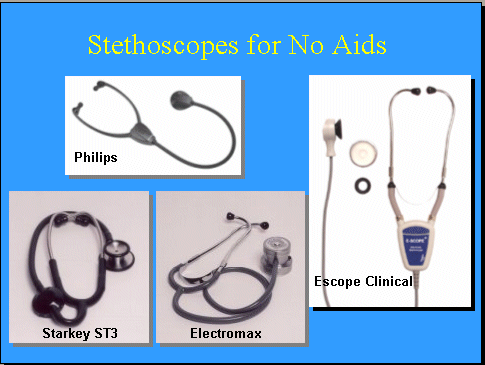
- Philips Medical Systems Electronic Stethoscope (PES) features a sleek design and simple push button control to change modes without interrupting auscultation. It was originally designed for cardiologists and offers approximately 24dB gain.
- Electromax stethoscope features a push button to power the unit. You must press the entire time you are listening to engage the stethoscope. Some professionals prefer this type of push button control to eliminate skin and clothing movement sounds from being amplified while positioning the stethoscope. This scope has a 2.5mm output jack. We have had limited success plugging in cables as the connection is located near the scope head, and can easily be dislodged or unplugged.
- E-Scope standard clinical model stethoscope offers about 27dB gain. It features simple controls directly on the stethoscope head.
- Starkey ST3 electronic stethoscope features two listening modes; ''H'' for Hearing Aid and ''S'' for Stethoscope mode. The two listening modes are useful as it allows one to listen to the patient in ''H'' mode, and then switching to ''S'' mode allows stethoscope use.
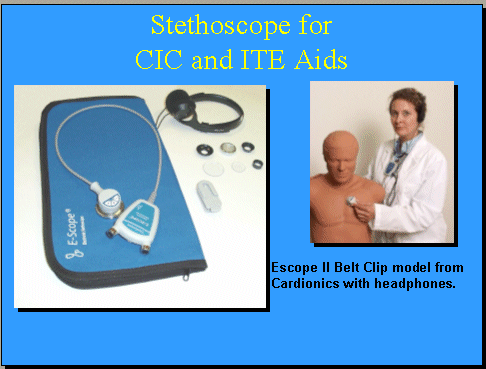
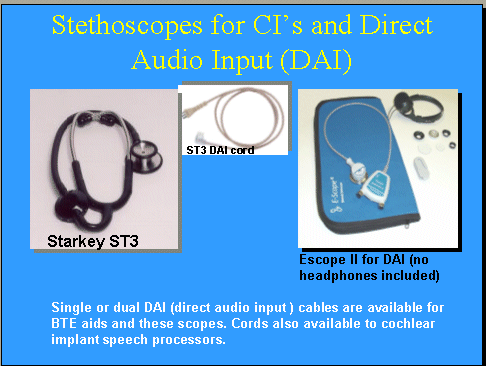
There is a stethoscope that is designed for CIC and ITE hearing aid users that uses headphones. Both stethoscopes below have direct audio input (DAI) capability and present some interface challenges of their own. The audio output jacks on these stethoscopes are amplified and can over-drive hearing aids. Therefore, an attenuated cable may be necessary. Attenuated cables or adapters are available and are dependent on the hearing aid manufacturer and model under consideration.
When planning to use DAI to interface hearing aids and stethoscopes, try to choose a hearing aid with good low frequency response for better performance, and, make sure the hearing aid microphone turns off when DAI is activated, so room noise doesn't interfere with the stethoscope.
- E-Scope Electronic Stethoscope:
- Starkey ST3 Amplified Stethoscope
This stethoscope is designed for a wide frequency range with a high level of amplification. The belt-clip model has an audio output jack for headphones, DAI (direct audio input) cable or CI cable.
The belt-clip model of the E-Scope with headphones is the only successful option we have consistently found for CIC and ITE hearing aid users who want to keep their hearing aids in. The headphones are high quality with good low frequency response and they plug into the output jack of the stethoscope. If a person experiences feedback with their ITE aids when using the telephone, they may have difficulty with the headphones. Turning the volume down on the aid and/or the stethoscope often produces good results.
The belt-clip model of the E-Scope also allows DAI connection with either single or Y-cord cables. If attenuation is needed, a cable or adapter may need to be made. Silhouettes have also been used successfully for hearing aids with telecoils. The telecoils must be powerful in order for this option to work. Importantly, telecoil use may not be possible in operating rooms or rooms with potential telecoil interference. One way to know if the environment is ''t-coil friendly'' is to simply turn your hearing aid to the telecoil position while standing in the area. If you hear interference or unusual humming, then using the telecoil is probably not a satisfactory option.
The E-Scope has successfully interfaced with some cochlear implant speech processors. The manufacturer or engineer will need to know the CI brand and model to build the appropriate cable.
Besides having two listening modes; ''H'' for Hearing Aid mode and ''S'' for Stethoscope mode, the ST3 has an output jack so a DAI cable can connect to the standard ''Euro' style plugs on audio shoes. The cable connection at the amplifier is non-standard and the cable is for single ear use only. There have been some difficulties with cable performance, but it is usually resolved with a little creative trial-and-error.
There are special modifications that can be made, projects being tested, and visual technologies emerging. An organization for medical professionals with hearing losses keeps up with the latest developments and technologies and, more importantly, provides networking to students and medical professionals.
- The stethoscopes mentioned in this article are FDA approved medical devices. Some engineers have rebuilt or modified amplifiers to meet the gain requirements for individuals. Other work that has been tested includes building a transmitter into the stethoscope to transmit via FM to a hearing aid.
- Currently, some hearing aids don't amplify sounds in the low frequencies, and others are not programmed maximally for low frequency emphasis, such as that needed for heart and breath sounds. Some people have observed that when a programmable hearing aid is programmed to amplify the necessary low frequencies, then interfacing the hearing aid to the stethoscope is the only remaining issue. Appropriate ''stethoscope programming'' for this specific purpose is encouraged, and can easily be accomplished in many hearing aids with multiple memory functions.
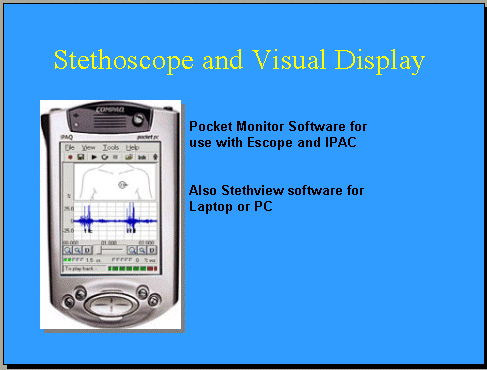
- Many years ago, a visual-based blood pressure monitor was available, but has since been discontinued. The newest visual device is software that displays heart, breath, bowel and Korotkoff sounds that runs on an IPAC. This is a first generation product and there is a learning curve, of course. Software also exists that runs on a laptop and is powered by a stethoscope for visual representation. These are available through Cardionics, Inc.
- A stethoscope has been developed that digitally transposes heart sounds to higher frequencies, where they may be more audible to certain people with certain hearing aids.
- There also is networking, support and advocacy available to medical professionals and students through the ''Association of Medical Professionals with Hearing Losses'' (AMPHL) organization.
Many options and alternatives have been developed to successfully interface hearing aids and stethoscopes. Hearing health care providers need to remain current in their knowledge regarding these issues and technologies. Technology will continue to improve to help this growing number of professionals who require amplification to successfully use stethoscopes.
References:
- 'ALDs and the Medical Professional' identifies typical issues and possible solutions to the communication demands on the job. Available at www.beyondhearingaids.com
- Manufacturer Websites:
- Cardionics Inc., www.cardionics.com
- Graham-Field Inc., www.grahamfield.com
- Philips Medical Systems, https://shop.medical.philips.com
- Starkey Labs, https://www.starkey.com/
- Westone Inc., https://www.westone.com/
********************************************************************************************
Rebecca Morris is the president of Effective Communication Solutions, Inc. and BeyondHearingAids.com. Ms. Morris specializes in amplified stethoscopes, FM systems and other ALDs to help individuals remain in the workforce. Contact her at [email protected].