Question
What is the difference between the NIOSH recommended noise exposure limit v. OSHA permissible noise exposure limit?
Answer
The US National Institute for Occupational Safety and Health (NIOSH) has a recommended standard for all industries (Centers for Disease Control and Prevention/NIOSH publication 98-126). This standard specifies an 85 dBA Recommended Exposure Limit (REL), and makes specific recommendations on the key elements of an effective hearing conservation program. The NIOSH standard is consistent with the exposure guidelines used by most scientific and regulatory bodies internationally, but NIOSH is not a regulatory agency and thus the standard is not mandated by law. It is designed to represent best scientific practice.
The US Occupational Safety and Health Administration (OSHA) exposure limit is regulatory - this is law and must be complied with. The NIOSH and OSHA limits are the two commonly used in the United States.
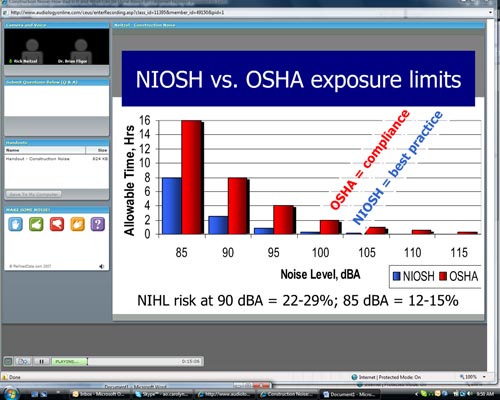
The graph below compares these two limits. As you can see, OSHA permits a worker to be exposed to 85 dBA for an allowable time of 16 hours per day. The NIOSH recommended allowable time for 85 dBA is 8 hrs per day. In addition to using a lower exposure limit than OSHA, the NIOSH standard uses a more protective 3 dB exchange rate that results in shorter allowable exposures at high noise levels than those of the OSHA regulation. For example, OSHA permits an exposure to 105 dBA for one hour per day, while NIOSH recommends that such an exposure last less than 5 minutes.
Hearing conservationists may be surprised to learn that neither the OSHA nor NIOSH limit is designed to protect every worker from suffering any NIHL. However, the NIOSH standard is the more health-protective limit of the two. For example, NIOSH estimates that approximately one in four workers exposed at the 90 dBA OSHA PEL eight hours per day over a 40 year working lifetime will suffer a compensable hearing loss from noise, compared to only about one in twelve workers exposed at the 85 dBA NIOSH REL.
Rick Neitzel is a Research Scientist in the University of Washington (UW) Department of Environmental and Occupational Health Sciences and a Certified Industrial Hygienist. He is also a Candidate in the Environmental and Occupational Hygiene PhD program at UW. He is President-Elect of the National Hearing Conservation Association, having previously served as Director of Communications and Treasurer, and sits on the Noise Committee of the American Industrial Hygiene Association. His research interests include quantitative and subjective exposure assessment in industrial and non-occupational settings, as well as development and evaluation of effective occupational health interventions.
This Ask the Expert was created from information presented in the course, Construction Noise: How Bad Is It and What Can Be Done About It? by Rick Neitzel, published on 6/19/08. The recorded course can be viewed here: audiologyonline.com/ceus/recordedcoursedetails.asp?class_id=11395.
Richard Neitzel, MS, PhD
Assistant Professor
Rick Neitzel is an Assistant Professor in the Risk Science Center within the University of Michigan's Department of Environmental Health Sciences. He has a PhD in Environmental and Occupational Hygiene from the University of Washington in 2009, and is a Certified Industrial Hygienist. He has been conducting research on noise and hearing loss since 1997. His current research interests include exposure assessment for noise and other hazards in occupational and non-occupational settings and development and evaluation of effective occupational and public health interventions. Rick Neitzel has no financial or non-financial relationships to disclose.
Related Courses
1https://www.audiologyonline.com/audiology-ceus/course/20q-audiologic-care-musicians-3610020Q: Audiologic Care for Musicians - Creating the Perfect HarmonyMusicians' ears are part of their instruments, and audiology expertise is important for amateur as well as professional musicians. Standard audiology clinic protocols and knowledge may not always be on target for musicians. This course uses an engaging Q & A format to discuss musicians' unique hearing needs and how audiologists can best meet them.textual, visual129USDSubscriptionUnlimited COURSE Access for $129/yearOnlineOnlyAudiologyOnlinewww.audiologyonline.com20Q: Audiologic Care for Musicians - Creating the Perfect HarmonyMusicians' ears are part of their instruments, and audiology expertise is important for amateur as well as professional musicians. Standard audiology clinic protocols and knowledge may not always be on target for musicians. This course uses an engaging Q & A format to discuss musicians' unique hearing needs and how audiologists can best meet them.36100OnlinePT60M
Musicians' ears are part of their instruments, and audiology expertise is important for amateur as well as professional musicians. Standard audiology clinic protocols and knowledge may not always be on target for musicians. This course uses an engaging Q & A format to discuss musicians' unique hearing needs and how audiologists can best meet them.
2https://www.audiologyonline.com/audiology-ceus/course/innovative-audiologic-care-delivery-38661Innovative Audiologic Care DeliveryThis four-course series highlights the next generation of audiology innovators and their pioneering approaches to meeting unmet audiologic needs in their communities and beyond. This peer-to-peer educational series highlights researchers, clinicians, and business owners and their pioneering ideas, care delivery models, and technologies which provide desperately needed niche services and audiologic care.auditory, textual, visual129USDSubscriptionUnlimited COURSE Access for $129/yearOnlineOnlyAudiologyOnlinewww.audiologyonline.comInnovative Audiologic Care DeliveryThis four-course series highlights the next generation of audiology innovators and their pioneering approaches to meeting unmet audiologic needs in their communities and beyond. This peer-to-peer educational series highlights researchers, clinicians, and business owners and their pioneering ideas, care delivery models, and technologies which provide desperately needed niche services and audiologic care.38661OnlinePT240M
This four-course series highlights the next generation of audiology innovators and their pioneering approaches to meeting unmet audiologic needs in their communities and beyond. This peer-to-peer educational series highlights researchers, clinicians, and business owners and their pioneering ideas, care delivery models, and technologies which provide desperately needed niche services and audiologic care.
3https://www.audiologyonline.com/audiology-ceus/course/assessment-firearm-noise-exposures-and-31240Assessment of Firearm Noise Exposures and Hearing Loss PreventionThis seminar will describe the magnitude of firearm noise exposure and will describe noise reduction solutions and hearing protection recommendations.auditory, textual, visual129USDSubscriptionUnlimited COURSE Access for $129/yearOnlineOnlyAudiologyOnlinewww.audiologyonline.comAssessment of Firearm Noise Exposures and Hearing Loss PreventionThis seminar will describe the magnitude of firearm noise exposure and will describe noise reduction solutions and hearing protection recommendations.31240OnlinePT60M
4https://www.audiologyonline.com/audiology-ceus/course/telehealth-and-modern-hearing-conservation-38412Telehealth and Modern Hearing ConservationAn introduction and examination of the role of teleaudiology in modern audiologic practice are discussed in this course. In particular, as it relates to non-regulated hearing conservation in the modern workforce. This course is part of a four-course series, Destroying the Box: Innovative Audiologic Care Delivery which highlights the next generation of audiology innovators and their pioneering approaches to meeting unmet audiologic needs in their communities and beyond.auditory, textual, visual129USDSubscriptionUnlimited COURSE Access for $129/yearOnlineOnlyAudiologyOnlinewww.audiologyonline.comTelehealth and Modern Hearing ConservationAn introduction and examination of the role of teleaudiology in modern audiologic practice are discussed in this course. In particular, as it relates to non-regulated hearing conservation in the modern workforce. This course is part of a four-course series, Destroying the Box: Innovative Audiologic Care Delivery which highlights the next generation of audiology innovators and their pioneering approaches to meeting unmet audiologic needs in their communities and beyond.38412OnlinePT60M
An introduction and examination of the role of teleaudiology in modern audiologic practice are discussed in this course. In particular, as it relates to non-regulated hearing conservation in the modern workforce. This course is part of a four-course series, Destroying the Box: Innovative Audiologic Care Delivery which highlights the next generation of audiology innovators and their pioneering approaches to meeting unmet audiologic needs in their communities and beyond.
5https://www.audiologyonline.com/audiology-ceus/course/hearing-protection-matters-delivering-safety-41231Hearing Protection Matters: Delivering Hearing Safety and Hearing Conservation in Your CommunityThis course reviews the danger of noise exposure, the importance of hearing conservation service delivery, and the range of appropriate Personal Protective Equipment (PPE) designed to protect against noise induced hearing loss.auditory, textual, visual129USDSubscriptionUnlimited COURSE Access for $129/yearOnlineOnlyAudiologyOnlinewww.audiologyonline.comHearing Protection Matters: Delivering Hearing Safety and Hearing Conservation in Your CommunityThis course reviews the danger of noise exposure, the importance of hearing conservation service delivery, and the range of appropriate Personal Protective Equipment (PPE) designed to protect against noise induced hearing loss.41231OnlinePT30M
This course reviews the danger of noise exposure, the importance of hearing conservation service delivery, and the range of appropriate Personal Protective Equipment (PPE) designed to protect against noise induced hearing loss.