
Music and Sound Quality With MED-EL Cochlear Implants
Learning Outcomes
- After this course, participants will be able to explain why music listening presents unique challenges for cochlear implant recipients compared to speech perception.
- After this course, participants will be able to describe how Fine Structure Processing (FSP) coding strategies improve pitch perception and music enjoyment for cochlear implant recipients.
- After this course, participants will be able to identify the relationship between electrode insertion depth, cochlear anatomy, and sound quality outcomes in cochlear implant recipients.
Introduction
Music occupies a unique and powerful place in human experience. As cognitive psychologist Steven Pinker, Ph.D., once wrote, music is “auditory cheesecake, an exquisite confection crafted to tickle the sensitive spots of at least six of our mental faculties.” And Confucius observed simply that music “produces a kind of pleasure which human nature cannot do without.” These sentiments capture something that audiologists and hearing healthcare professionals understand deeply: for people with hearing loss, the restoration of music enjoyment is not a luxury—it is a meaningful dimension of quality of life.
For decades following the widespread adoption of cochlear implantation, speech understanding improved steadily while music remained a persistent challenge. Recipients who had previously enjoyed natural hearing described cochlear implant sound as harsh, scattered, and hollow—far from the rich listening experiences they remembered. This course examines the science behind those challenges and the technological advances that have made better music sound quality a reality for cochlear implant recipients.
Why Does Music Make Us Feel Emotions?
To understand why music is so difficult to code in a cochlear implant, it helps to understand what makes music unique as a sound. Unlike speech, which can be understood even when compromised—think of a cartoon character’s voice or a phone call with poor reception—music depends on precise acoustic relationships that are easily disrupted.
In his best-selling book This Is Your Brain on Music, neuroscientist Daniel J. Levitin describes the remarkable efficiency of musical patterns in triggering memory and emotion. Anyone who has seen Alfred Hitchcock’s Psycho will instantly associate screeching violins with that iconic shower scene. A sequence of plucked violin notes in an ascending pattern brings to mind a cartoon character sneaking up a staircase. Even a simple three-chord guitar progression—B minor, F# major, and A major—can cause virtually any listener to recognize the Eagles’ “Hotel California.” Music is built from a small, finite set of notes recombined into seemingly endless variations, yet those combinations carry powerful emotional and memory associations.
Several elements contribute to music’s emotional complexity. Melody, harmony, dissonance, rhythm, beat, and reverberation all work together in ways that speech does not require. While speech fits neatly within a limited frequency and loudness range—sometimes depicted as “the speech banana” on an audiogram—music demands far more acoustic detail.
One of the most important and least understood of those elements is timbre. Sometimes referred to as “sound color,” timbre is what allows a listener to distinguish a trumpet from a flute even when both instruments are playing the same note at the same loudness. It is also what gives a singer’s voice its distinctive quality. Music further depends on precise mathematical pitch relationships that distinguish major from minor chords, and it is through these relationships that emotions and memories become so deeply linked to sound. A melody unheard for years can surface in an instant, often carrying with it the full emotional weight of the experience it was first associated with.
As cochlear implant technology advanced and speech understanding improved, the gap between what recipients could understand and what they could enjoy became more apparent. Recipients who had previously experienced natural hearing were particularly affected. They described cochlear implant sound as resembling cartoon characters—tinny and artificial—rather than the resonant, full-bodied quality they had hoped to regain. While some people listened to music through their implants, those experiences were largely unsatisfying. Studies confirmed that cochlear implant users enjoyed music significantly less than they had before losing their hearing (Pijl, 1997; Gfeller et al., 2000). The words recipients used to describe music were telling: unpleasant, scattered, noisy, dull, distorted, harsh, and shrill (Gfeller et al., 2002).
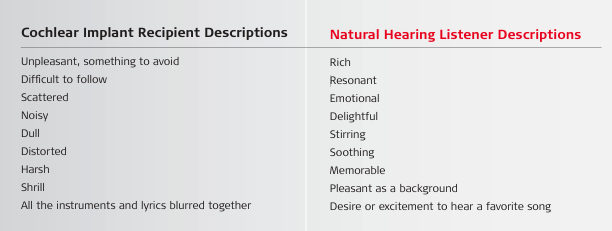
Table 1. summarizes the contrast between how natural hearing listeners and cochlear implant recipients typically describe their music experiences.
Studies have also shown that the auditory brainstem response waves from MED-EL implant recipients closely resemble those of people with natural hearing (Zirn et al., 2015), and that adults and children show rapid improvement in speech recognition within weeks to months of implant activation (Ma et al., 2023). When MED-EL’s founders developed the first cochlear implant in the 1970s, their primary goal was to restore communication (Hochmair-Desoyer et al., 1980). They quickly recognized, however, that communication ability was only part of the picture. Restoring music enjoyment became an equally important objective.
A Solution to the Problem
The central challenge underlying poor music perception in cochlear implant recipients was the absence of fine structure in sound coding. Naturally hearing ears process sound using two types of information: the envelope (the overall shape of a sound wave) and the fine structure (the rapid, intricate oscillations within that envelope). Fine structure is especially important at low frequencies, and it is critical for pitch perception—particularly for music.
A coding strategy functions as the set of instructions that tells a cochlear implant how and when to stimulate each electrode contact in the cochlea. At the time MED-EL began researching this problem, no implant system included fine structure in its coding—despite research suggesting that fine structure information could be important for pitch and music perception (Javel & Shepherd, 2000; Wilson et al., 1997; Smith et al., 2002). The cochlea is naturally tuned so that different locations along the spiral respond to different pitches—lower frequencies at the apex, higher frequencies at the base. Stimulating different electrode contacts along an array can take advantage of this natural arrangement, but using place coding alone was not sufficient to deliver an enjoyable music experience.
MED-EL’s researchers recognized an additional challenge: fine structure coding works only in the low frequencies, which are located in the deepest turns of the cochlea—the apex. To deliver fine structure information, electrodes would need to reach that region. This requirement pointed directly to one of MED-EL’s key differentiators: the FLEX electrode arrays.
MED-EL’s FLEX electrodes are long, thin, and flexible, with a wave shape designed to avoid damaging the cochlea’s delicate membranes. Research has confirmed that these electrodes do not cause the kind of structural damage more commonly associated with thicker, stiffer pre-curved electrode arrays (Gstoettner et al., 1997; Carlson et al., 2011; Helbig et al., 2011). Pre-curved arrays, designed for a one-size-fits-all insertion, are more likely to insert incorrectly, fold over on themselves, or injure the cochlear membranes (Finley et al., 2008; Wanna et al., 2014). FLEX electrodes, available in multiple lengths to accommodate different cochlear sizes, provided the platform needed to pursue fine structure coding.
In 2008, MED-EL introduced the Fine Structure Processing (FSP) coding strategy—the first coding strategy to incorporate fine structure information into cochlear implant sound delivery (U.S. FDA, 2008). The FS4 and FS4-P strategies followed in 2014 (U.S. FDA, 2013). It is worth noting that Fine Structure coding remains among the only new coding strategies introduced in recent years; one commonly used alternative strategy dates to 1999 (U.S. FDA, 1999; U.S. FDA, 2006). Fine Structure coding improved not only music perception, but also speech understanding in both quiet and noisy listening environments (Riss et al., 2009; Vermeire et al., 2010; Kleine Punte et al., 2014).
Music Appreciation
The clinical impact of Fine Structure coding on music enjoyment was significant and measurable. Recipients using MED-EL’s first Fine Structure Processing strategy reported clear improvements in their ability to enjoy music, and most noted that they listened to music more often as a result (Müller et al., 2012; Boeckmann-Barthel et al., 2013).
Specifically, recipients reported that music sounded more pleasant, and that their listening experiences improved across multiple dimensions: melody recognition, the ability to distinguish between instruments and singing voices, appreciation of both familiar and unfamiliar music, identification of individual instruments within a complex musical piece, and overall sound quality naturalness. Recipients also reported hearing more bass frequencies, which meaningfully enhanced their music experience.
These improvements were directly linked to MED-EL’s complete cochlear coverage philosophy, which is built on the principle of using as much of the cochlea as possible. By implanting long electrodes that reach into the cochlea’s low-frequency apex, recipients gain access to the fine structure zone—and to the richer, more natural pitch information it provides.
The importance of deep insertion was demonstrated clearly in a study comparing full cochlear stimulation to shallower stimulation simulated by turning off the most apically placed electrodes (Landwehr et al., 2014). This approach mimicked what recipients might experience with a shorter electrode array. The researcher summarized the findings simply: deactivating the four most apical electrodes “always yielded a significantly lower quality rating than using all.” A separate study found dramatic shifts in sound quality with the deactivation of just one or two of the most apical electrodes (Dorman et al., 2019). Together, these findings support the view that using the whole cochlea matters for music sound quality.
In a study of six patients who had MED-EL devices in one ear and Cochlear Nucleus devices in the other, researchers asked participants to compare sound quality for both speech and music across their differently implanted ears (Harris et al., 2011). Five patients showed no difference in speech recognition scores, but four of those five reported that their MED-EL implants sounded noticeably different: more natural, less tinny, and more reverberant. Additional research found that MED-EL implant recipients using Fine Structure coding rated sound quality more similarly to normal hearing listeners than they did with previous coding strategies (Roy et al., 2015; Roy et al., 2016). Deeply inserted long electrodes better reflected the naturally hearing cochlea’s pitch-based arrangement and offered a wider effective frequency range (Hochmair et al., 2015; Schatzer et al., 2014).
Is Better Sound Quality a Realistic Goal for Cochlear Implant Recipients?
The short answer, supported by an expanding body of research, is yes—but with important qualifications tied to electrode choice and insertion depth.
For many MED-EL recipients, more natural sound quality has become a realistic and achievable outcome. The brain does adapt over time, and some adjustment to the implant’s sound quality occurs with experience and practice. However, research has raised serious questions about whether the brain can ever truly compensate for the large pitch mismatch that occurs when a short electrode is inserted at a shallow depth. Pitch conflicts associated with shallow insertions often persist even after years of listening experience (McDermott et al., 2009; Tan et al., 2017; Dorman et al., 2022).
Research with recipients who have single-sided deafness (SSD)—one ear with normal hearing and one with significant hearing loss—has shed particularly valuable light on this question. Because these individuals can hear normally in one ear, they are uniquely positioned to compare the pitch and sound quality of their implanted ear against a natural hearing reference. This has allowed researchers to create audio demonstrations that let anyone with natural hearing experience what a cochlear implant sounds like from the recipient’s perspective, for the very first time (Dorman et al., 2019; Dorman et al., 2020; Dorman et al., 2022).
Studies with this group confirmed that deeper insertions with long, free-fitting electrode arrays can produce pitches that closely match natural hearing and contribute to more natural sound quality (Dorman et al., 2019). When the inserted electrode is mismatched due to a shallow insertion with a pre-shaped array, the resulting sound quality is typically described as tinny, robotic, or cartoonish—reflecting an unnaturally high-pitched signal (Dorman et al., 2020). Dorman and colleagues concluded that despite these listeners sometimes achieving good speech understanding scores, their sound quality does not approach that of a naturally hearing ear, even after years of use. Furthermore, when recipients report that sound becomes “more normal” over time, this likely reflects familiarity rather than genuine perceptual improvement, since they hear the same signal every day (Dorman et al., 2022).
These findings underscore a critical clinical principle: each cochlea is different. Cochlear dimensions vary meaningfully from person to person—and even between a single individual’s two ears. Electrode selection that accounts for individual cochlear anatomy, rather than defaulting to a one-size-fits-all approach, is essential to achieving the best possible outcomes.
OTOPLAN and Anatomy-Based Fitting
Advances in surgical planning and sound processor programming have made individualized cochlear implant care more achievable than ever before. Two developments in particular are expanding the possibilities for audiologists and their patients: OTOPLAN surgical planning software and Anatomy-Based Fitting.
OTOPLAN, a product of CASCINATION AG, allows surgeons to take more detailed cochlear measurements prior to surgery than traditional CT or MRI scanning alone can provide (Canfarotta et al., 2019; Paouris et al., 2023; Spiegel et al., 2022). These measurements support the selection of the optimal electrode length for each individual cochlea. Insertion depth can be described in two ways: by the length of the electrode in millimeters, and by the angular insertion depth (AID)—the number of degrees the electrode travels around the spiral shape of the cochlea. One complete turn equals 360 degrees; two full turns equal 720 degrees. Research indicates that insertion angles of 600 degrees or more are associated with better outcomes, and achieving this depth requires a long, deeply inserted electrode array such as MED-EL’s FLEX electrodes (Canfarotta et al., 2020; Canfarotta et al., 2021). FLEX arrays are available in lengths ranging from 20 to 34 millimeters, enabling personalized fitting to each cochlea’s unique size and shape.
Building on OTOPLAN’s anatomical data, MED-EL developed Anatomy-Based Fitting (also called place-based mapping), which received FDA approval in 2022 (U.S. FDA, 2022). Using OTOPLAN to identify the precise post-surgical location of each electrode contact, audiologists can reassign the frequency delivered to each electrode to more closely match the natural tonotopic arrangement of the individual patient’s cochlea (Li et al., 2021). This represents a fundamental shift in how cochlear implants are programmed: rather than applying a generic frequency-to-electrode mapping, clinicians can now customize the processor’s program to reflect each patient’s actual anatomy.
Anatomy-Based Fitting may also help preserve residual acoustic hearing that survives implantation, and it offers a pathway for matching pitch between the implanted ear and the opposite ear—whether that ear has natural hearing, a hearing aid, or a second cochlear implant (Dillon et al., 2021; Kurz et al., 2023). Research examining how Anatomy-Based Fitting can further improve music listening experiences is ongoing. The overarching goal—delivering sound quality as close to natural as possible—continues to drive MED-EL’s research and development efforts.
Summary
Cochlear implant technology has delivered transformative benefits in speech understanding for people with hearing loss. But the story does not end with speech. The pursuit of natural sound quality and music enjoyment has led to a deeper understanding of how cochlear implant outcomes are shaped—not only by the sound processor and coding strategy, but by the interaction between electrode design, insertion depth, and individual cochlear anatomy. The following principles reflect the current state of evidence:
- Speech understanding scores do not tell the whole story. Poor sound quality can coexist with acceptable performance on speech tests while still producing frustrating experiences with music and everyday listening.
- Electrode design and insertion depth matter. Placing electrodes safely in the cochlea’s apex, where fine structure information resides, requires long, flexible, free-fitting arrays designed for deep insertion.
- Fine Structure coding depends on deep electrode placement. Only when an electrode reaches the fine structure zone can MED-EL’s FSP, FS4, and FS4-P strategies deliver their full benefit—improving pitch, sound quality, and music enjoyment.
- OTOPLAN supports personalized electrode selection. By enabling detailed pre-surgical cochlear measurements, OTOPLAN helps surgeons choose the right electrode length for each individual, rather than defaulting to a one-size-fits-all approach.
- Anatomy-Based Fitting opens new possibilities for personalized programming. For the first time, audiologists can incorporate each patient’s electrode contact locations into sound processor mapping, refining the recipient’s experience of pitch and sound quality.
The choices made at the time of implantation have long-lasting consequences. Internal device factors—the implant, the electrode, the depth of insertion—are just as important as the external audio processor, because those choices shape what the recipient will hear for the rest of their life. A personalized approach to cochlear implants, grounded in individual anatomy and supported by the latest advances in coding and mapping, offers the best foundation for music enjoyment and sound quality over the implant journey.
References
Boeckmann-Barthel, M., Ziese, M., Rostalski, D., Arens, C., & Verhey, J. L. (2013). Melody and chord discrimination of cochlear implant users in different pitch ranges. Cochlear Implants International, 14(5), 246–251. https://doi.org/10.1179/1754762812Y.0000000024
Canfarotta, M. W., Dillon, M. T., Brown, K. D., Pillsbury, H. C., Dedmon, M. M., & O’Connell, B. P. (2022). Insertion depth and cochlear implant speech recognition outcomes: A comparative study of 28- and 31.5-mm lateral wall arrays. Otology & Neurotology, 43(2), 183–189. https://doi.org/10.1097/MAO.0000000000003416
Canfarotta, M. W., Dillon, M. T., Buchman, C. A., Buss, E., O’Connell, B. P., Rooth, M. A., King, E. R., Pillsbury, H. C., Adunka, O. F., & Brown, K. D. (2021). Long-term influence of electrode array length on speech recognition in cochlear implant users. Laryngoscope, 131(4), 892–897. https://doi.org/10.1002/lary.28949
Canfarotta, M. W., Dillon, M. T., Buss, E., Pillsbury, H. C., Brown, K. D., & O’Connell, B. P. (2019). Validating a new tablet-based tool in the determination of cochlear implant angular insertion depth. Otology & Neurotology, 40(8), 1006–1010. https://doi.org/10.1097/MAO.0000000000002296
Canfarotta, M. W., Dillon, M. T., Buss, E., Pillsbury, H. C., Brown, K. D., & O’Connell, B. P. (2020). Frequency-to-place mismatch: Characterizing variability and the influence on speech perception outcomes in cochlear implant recipients. Ear and Hearing, 41(5), 1349–1361. https://doi.org/10.1097/AUD.0000000000000864
Carlson, M. L., Driscoll, C. L., Gifford, R. H., Service, G. J., Tombers, N. M., Hughes-Borst, B. J., Neff, B. A., & Beatty, C. W. (2011). Implications of minimizing trauma during conventional cochlear implantation. Otology & Neurotology, 32(6), 962–968. https://doi.org/10.1097/MAO.0b013e3182204526
Dillon, M. T., Canfarotta, M. W., Buss, E., & Hopfinger, J. (2022). Effect of place-based versus default mapping procedures on masked speech recognition. American Journal of Audiology, 31(2), 322–337. https://doi.org/10.1044/2022_AJA-21-00123
Dillon, M. T., Canfarotta, M. W., Buss, E., Hopfinger, J., & O’Connell, B. P. (2021). Effectiveness of place-based mapping in electric-acoustic stimulation devices. Otology & Neurotology, 42(1), 197–202. https://doi.org/10.1097/MAO.0000000000002965
Dorman, M. F., Cook Natale, S., Baxter, L., Zeitler, D. M., Carlson, M. L., & Noble, J. H. (2019). Cochlear place of stimulation is one determinant of cochlear implant sound quality. Audiology & Neuro-Otology, 24(5), 264–269. https://doi.org/10.1159/000503217
Dorman, M. F., Natale, S. C., Noble, J. H., & Zeitler, D. M. (2022). Upward shifts in the internal representation of frequency can persist over a 3-year period for cochlear implant patients fit with a relatively short electrode array. Frontiers in Human Neuroscience, 16, Article 863891. https://doi.org/10.3389/fnhum.2022.863891
Dorman, M. F., Natale, S. C., Zeitler, D. M., Baxter, L., & Noble, J. H. (2020). Looking for Mickey Mouse™ but finding a munchkin: The perceptual effects of frequency upshifts for single-sided deaf patients. Journal of Speech, Language, and Hearing Research, 63(9), 3493–3499. https://doi.org/10.1044/2019_JSLHR-H-18-0389
Finley, C. C., Holden, T. A., Holden, L. K., Whiting, B. R., Chole, R. A., Neely, G. J., Hullar, T. E., & Skinner, M. W. (2008). Role of electrode placement as a contributor to variability in cochlear implant outcomes. Otology & Neurotology, 29(7), 920–928. https://doi.org/10.1097/MAO.0b013e318184f492
Gfeller, K., Christ, A., Knutson, J. F., Witt, S., Murray, K. T., & Tyler, R. S. (2000). Musical backgrounds, listening habits, and aesthetic enjoyment of adult cochlear implant recipients. Journal of the American Academy of Audiology, 11(7), 390–406.
Gfeller, K., Witt, S., Woodworth, G., Mehr, M. A., & Knutson, J. (2002). Effects of frequency, instrumental family, and cochlear implant type on timbre recognition and appraisal. Annals of Otology, Rhinology & Laryngology, 111(4), 349–356. https://doi.org/10.1177/000348940211100412
Gstoettner, W., Franz, P., Hamzavi, J., Plenk, H., Jr., Baumgartner, W., & Czerny, C. (1999). Intracochlear position of cochlear implant electrodes. Acta Oto-Laryngologica, 119(2), 229–233. https://doi.org/10.1080/00016489950181729
Harris, R. L., Gibson, W. P. R., Johnson, M., Brew, J., Bray, M., & Psarros, C. (2011). Intra-individual assessment of speech and music perception in cochlear implant users with contralateral Cochlear™ and MED-EL™ systems. Acta Oto-Laryngologica, 131(12), 1270–1278. https://doi.org/10.3109/00016489.2011.616225
Helbig, S., Baumann, U., Hey, C., & Helbig, M. (2011). Hearing preservation after complete cochlear coverage in cochlear implantation with the free-fitting FLEXSOFT electrode carrier. Otology & Neurotology, 32(6), 973–979. https://doi.org/10.1097/MAO.0b013e31822558c4
Hochmair, I., Hochmair, E., Nopp, P., Waller, M., & Jolly, C. (2015). Deep electrode insertion and sound coding in cochlear implants. Hearing Research, 322, 14–23. https://doi.org/10.1016/j.heares.2014.10.006
Hochmair-Desoyer, I. J., Hochmair, E. S., Fischer, R. E., & Burian, K. (1980). Cochlear prostheses in use: Recent speech comprehension results. Archives of Oto-Rhino-Laryngology, 229(2), 81–98. https://doi.org/10.1007/BF00454232
Javel, E., & Shepherd, R. K. (2000). Electrical stimulation of the auditory nerve. III. Response initiation sites and temporal fine structure. Hearing Research, 140(1–2), 45–76. https://doi.org/10.1016/s0378-5955(99)00186-0
Kleine Punte, A., De Bodt, M., & Van de Heyning, P. (2014). Long-term improvement of speech perception with the fine structure processing coding strategy in cochlear implants. ORL: Journal for Oto-Rhino-Laryngology and Its Related Specialties, 76(1), 36–43. https://doi.org/10.1159/000360479
Kurz, A., Herrmann, D., Hagen, R., & Rak, K. (2023). Using anatomy-based fitting to reduce frequency-to-place mismatch in experienced bilateral cochlear implant users: A promising concept. Journal of Personalized Medicine, 13(7), Article 1109. https://doi.org/10.3390/jpm13071109
Landwehr, M., Fürstenberg, D., Walger, M., von Wedel, H., & Meister, H. (2014). Effects of various electrode configurations on music perception, intonation and speaker gender identification. Cochlear Implants International, 15(1), 27–35. https://doi.org/10.1179/1754762813Y.0000000037
Levitin, D. J. (2006). This is your brain on music: The science of a human obsession. Dutton/Penguin Books.
Li, H., Helpard, L., Ekeroot, J., Rohani, S. A., Zhu, N., Rask-Andersen, H., Ladak, H. M., & Agrawal, S. (2021). Three-dimensional tonotopic mapping of the human cochlea based on synchrotron radiation phase-contrast imaging. Scientific Reports, 11(1), Article 4437. https://doi.org/10.1038/s41598-021-83225-w
Ma, C., Fried, J., Nguyen, S. A., Schvartz-Leyzac, K. C., Camposeo, E. L., Meyer, T. A., Dubno, J. R., & McRackan, T. R. (2023). Longitudinal speech recognition changes after cochlear implant: Systematic review and meta-analysis. The Laryngoscope, 133(5), 1014–1024. https://doi.org/10.1002/lary.30354
McDermott, H., Sucher, C., & Simpson, A. (2009). Electro-acoustic stimulation: Acoustic and electric pitch comparisons. Audiology and Neurotology, 14(Suppl. 1), 2–7. https://doi.org/10.1159/000206489
Müller, J., Brill, S., Hagen, R., Moeltner, A., Brockmeier, S.-J., Stark, T., Helbig, S., Maurer, J., Zahnert, T., Zierhofer, C., Nopp, P., & Anderson, I. (2012). Clinical trial results with the MED-EL fine structure processing coding strategy in experienced cochlear implant users. ORL: Journal for Oto-Rhino-Laryngology and Its Related Specialties, 74(4), 185–198. https://doi.org/10.1159/000337089
Paouris, D., Kunzo, S., & Goljerová, I. (2023). Validation of automatic cochlear measurements using OTOPLAN® software. Journal of Personalized Medicine, 13(5), Article 805. https://doi.org/10.3390/jpm13050805
Pijl, S. (1997). Labeling of musical interval size by cochlear implant patients and normally hearing subjects. Ear and Hearing, 18(5), 364–372. https://doi.org/10.1097/00003446-199710000-00002
Riss, D., Arnoldner, C., Reiss, S., Baumgartner, W. D., & Hamzavi, J. S. (2009). 1-year results using the Opus speech processor with the fine structure speech coding strategy. Acta Oto-Laryngologica, 129(9), 988–991. https://doi.org/10.1080/00016480802552485
Roy, A. T., Carver, C., Jiradejvong, P., & Limb, C. J. (2015). Musical sound quality in cochlear implant users: A comparison in bass frequency perception between Fine Structure Processing and High-Definition Continuous Interleaved Sampling strategies. Ear and Hearing, 36(5), 582–590. https://doi.org/10.1097/AUD.0000000000000170
Roy, A. T., Penninger, R. T., Pearl, M. S., Wuerfel, W., Jiradejvong, P., Carver, C., Buechner, A., & Limb, C. J. (2016). Deeper cochlear implant electrode insertion angle improves detection of musical sound quality deterioration related to bass frequency removal. Otology & Neurotology, 37(2), 146–151. https://doi.org/10.1097/MAO.0000000000000932
Schatzer, R., Vermeire, K., Visser, D., Krenmayr, A., Kals, M., Voormolen, M., Van de Heyning, P., & Zierhofer, C. (2014). Electric-acoustic pitch comparisons in single-sided-deaf cochlear implant users: Frequency-place functions and rate pitch. Hearing Research, 309, 26–35. https://doi.org/10.1016/j.heares.2013.11.003
Smith, Z. M., Delgutte, B., & Oxenham, A. J. (2002). Chimaeric sounds reveal dichotomies in auditory perception. Nature, 416(6876), 87–90. https://doi.org/10.1038/416087a
Spiegel, J. L., Polterauer, D., Hempel, J. M., Canis, M., Spiro, J. E., & Müller, J. (2022). Variation of the cochlear anatomy and cochlea duct length: Analysis with a new tablet-based software. European Archives of Oto-Rhino-Laryngology, 279(4), 1851–1861. https://doi.org/10.1007/s00405-021-06889-0
Tan, C. T., Martin, B., & Svirsky, M. A. (2017). Pitch matching between electrical stimulation of a cochlear implant and acoustic stimuli presented to a contralateral ear with residual hearing. Journal of the American Academy of Audiology, 28(3), 187–199. https://doi.org/10.3766/jaaa.15063
U.S. Food and Drug Administration. (1999, July 9). Cochlear Americas Advanced Combination Encoder (ACE) coding strategy FDA approval order. https://www.accessdata.fda.gov/scripts/cdrh/cfdocs/cfpma/pma.cfm?id=P970051S004
U.S. Food and Drug Administration. (2006, August 17). Advanced Bionics Hi Res Fidelity 120 coding strategy FDA approval order. https://www.accessdata.fda.gov/scripts/cdrh/cfdocs/cfpma/pma.cfm?id=P960058S049
U.S. Food and Drug Administration. (2008, February 18). MED-EL Corporation labeling changes. https://www.accessdata.fda.gov/scripts/cdrh/cfdocs/cfpma/pma.cfm?id=P000025S039
U.S. Food and Drug Administration. (2013, December 5). MAESTRO 4.1 software updated version. https://www.accessdata.fda.gov/scripts/cdrh/cfdocs/cfpma/pma.cfm?id=P000025S067
U.S. Food and Drug Administration. (2022, February 17). MAESTRO system software 9.0 changes. https://www.accessdata.fda.gov/scripts/cdrh/cfdocs/cfpma/pma.cfm?id=P000025S124
Vermeire, K., Punte, A. K., & Van de Heyning, P. (2010). Better speech recognition in noise with the fine structure processing coding strategy. ORL: Journal for Oto-Rhino-Laryngology and Its Related Specialties, 72(6), 305–311. https://doi.org/10.1159/000319748
Wanna, G. B., Noble, J. H., Carlson, M. L., Gifford, R. H., Dietrich, M. S., Haynes, D. S., Dawant, B. M., & Labadie, R. F. (2014). Impact of electrode design and surgical approach on scalar location and cochlear implant outcomes. Laryngoscope, 124(Suppl. 6), S1–S7. https://doi.org/10.1002/lary.24728
Wilson, B. S., Finley, C. C., Lawson, D. T., & Zerbi, M. (1997). Temporal representations with cochlear implants. The American Journal of Otology, 18(6, Suppl.), S30–S34.
Zirn, S., Arndt, S., Aschendorff, A., & Wesarg, T. (2015). Interaural stimulation timing in single sided deaf cochlear implant users. Hearing Research, 328, 148–156. https://doi.org/10.1016/j.heares.2015.08.010