Question
With the new Bluetooth advancements in hearing aids, are telecoils still relevant?
Answer
Telecoils are the “OG” of wireless connectivity in hearing aids. Introduced in the late 1930s and still in use in hearing aids today, telecoils bring sound from remote sources directly to users’ hearing aids. This can provide them with a clearer telephone signal, better access to amplified sound in public spaces, and even better hearing of sound sources in the home like the TV and the doorbell. If the person’s hearing aids are equipped with telecoils, this additional access to sound requires nothing more than switching to their telecoil setting when there is a signal available. In public spaces that are “looped”, availability of a signal that can be picked up by telecoils is indicated by a well-established and easily recognized standard symbol, such as that displayed on New York City taxi cabs (Figure 1). In fact, the ease of use and standardization for telecoils are so attractive from a usability perspective that they served as the model for the development of Auracast in the new Bluetooth standard. The 5.2 Bluetooth standard allows for one-to-many streaming, unlike previous versions of Bluetooth which were limited to one-to-one connections. This new standard enables Auracast broadcast audio, which is expected to become the next generation in assistive listening technology.

Figure 1. New York City taxicab with telecoil accessibility signage
As newer wireless communication technologies in hearing aids have been introduced, telecoils have not become obsolete or replaced, and are not expected to for many years to come. Instead, there will be a long period during which multiple wireless technologies will continue to co-exist. For people who are accustomed to telecoils and are pleased with their performance, telecoils in hearing aids will be available for quite a while into the future. People getting hearing aids for the first time may also be good candidates for telecoils if it is known that there will be opportunities where they will benefit from using them, such as at places of worship, theaters, or even taxi cabs. If a hearing aid user decides that they prefer a smaller style of hearing aid which may not accommodate a telecoil, most hearing aid styles at all technology levels offer connectivity to wireless accessories that can stream audio to the hearing aids. In these cases, users can still benefit from loop systems which they may encounter if they add a wireless accessory that contains a telecoil, such as the ReSound Multi-Mic+. In this setup, the signal from the loop system can be picked up by the accessory device and streamed to the hearing aids. In addition to the acoustic microphones and the telecoil, the Multi-Mic+ also can receive direct audio input (DAI) as well as input from a 3.5 mm headphone jack, maximizing the opportunities to benefit from wireless connectivity.
Telecoils and loop systems have been around for nearly a century and continue to offer strong benefits to users. However, there are some disadvantages that newer wireless technologies eventually will solve. Some of the pros and cons of telecoils and loop systems are listed in the table below.
Pros | Cons |
Mature technology | Susceptible to interference |
Easy to use | Complex installation of loop systems |
Low or no added cost to the hearing aid user | Sound reception dependent on position within the looped area |
Unlimited number of people can access the transmission | No encryption (no private transmission) |
Many existing installations | Spillover of signal; problematic for private homes |
Standardized with well-established signposts | Sound quality can be inconsistent, particularly for music |
Table 1. Pros and cons of telecoils and loop systems
With new wireless accessibility-for-all systems such as Auracast on the horizon, the tried-and-true telecoil will maintain it’s important role for hearing aid users for some time. The good news is that telecoils, as well as support for FM systems, proprietary wireless systems and Auracast can all exist concurrently in a hearing aid.
Likewise, multiple connectivity technologies can co-exist in transmitting devices. A new, cutting-edge transmitter called Auraloop by Opus provides a hybrid kiosk which includes a magnetic loop for telecoil transmission as well as Auracast protocol. (Figure 2). Ideal situations for an Auraloop device include communicating with a bank teller, ticket booth agent or medical office receptionist. In these scenarios, hearing aid users will receive clear audio reception and have a positive experience whether they have a telecoil or Auracast-ready hearing aid. As wireless technologies advance further, the future holds countless exciting and unique opportunities for telecoil and Auracast alike.
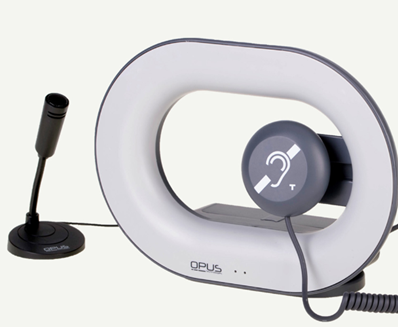
Figure 2. Auraloop hybrid kiosk
Continued and its subsidiaries provide professional education authored by qualified Subject Matter Experts for continuing education purposes. These materials are intended for educational purposes and do not constitute medical advice or a substitute for individual clinical judgment. Continued is not a clinical healthcare provider; the licensed professional is solely responsible for ensuring that the application of any techniques or information presented is within their legal scope of practice and jurisdictional requirements.