

Vestibular System and Neurodevelopmental Disorders
VESTIBULAR DEVELOPMENT IN EARLY CHILDHOOD
AudiologyOnline: Dr. Marcelli, why is the vestibular system so important in early neurodevelopment?
Dr. Marcelli: The newborn must quickly adapt to the effect of gravity, managing head position, sitting position, standing posture, and walking. For this reason, it is not surprising that the vestibular system (VS) is the first to develop. The labyrinth is morphologically complete at birth, the connections with the oculomotor nuclei are already present between the 12th and 24th week of gestation, and the vestibular branch of the VIII nerve is the first to complete myelination.
AudiologyOnline: How does vestibular function mature during infancy and childhood?
Dr. Marcelli: This results in extremely active vestibular activity from the very first months of life. For example, as early as 2 months, head rotation stimulates the labyrinth, which generates a slow counter-rotational movement of the eyeballs, known as the doll's eye reflex, without the rapid phase. As is known, the rapid phase originates from the brainstem and develops later. This finding is confirmed by thermal stimulation, which generates the same slow counter-rotational phase.
Between 3 and 6 months, the optokinetic response appears, indicating proper integration between visual stimulus and vestibular nuclei. At 4 months, the vestibulo-collic reflex can be generated, confirming the normal development of the saccule macula, the lower component of the vestibular branch, and the vestibular nuclei.
In line with its importance in the acquisition of motor skills, the vestibular apparatus is very active between 6 and 12 months of life. Between 10 and 14 years, cerebellar inhibitory activity renders the VS functionally similar to that of an adult. Control of saccadic and pursuit eye movements also reaches full functionality very early, becoming fully active by the age of 2.
DEVELOPMENTAL WARNING SIGNS
AudiologyOnline: Which clinical signs may suggest abnormal or incomplete vestibular development in children?
Dr. Marcelli: Among the primary developmental anomalies is the absence of the vestibulo-ocular reflex at 10 months. It is now well known that incomplete or partial development of the vestibular apparatus has clear repercussions on the development of neuromotor skills.
Possible warning signs include lack of head control at 3 months, hypotonia with a ragdoll appearance, and backward head drop when the infant is lifted from a lying position between 4 and 7 months. Other signs include failure to maintain a sitting position, inability to crawl, or inability to hold a seated position even when supported between 9 and 12 months.
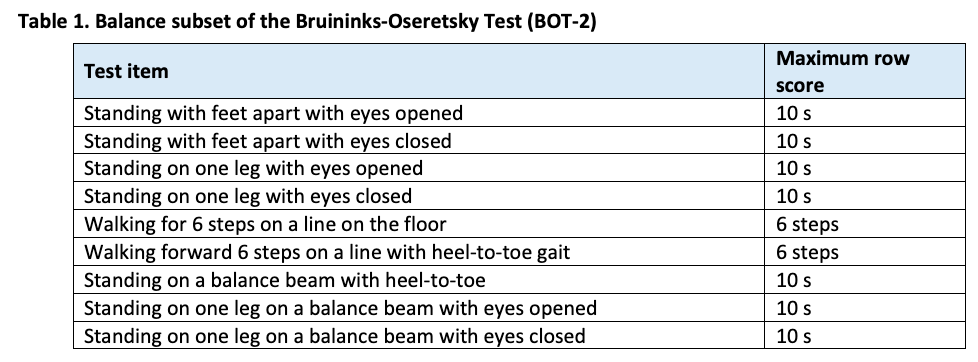
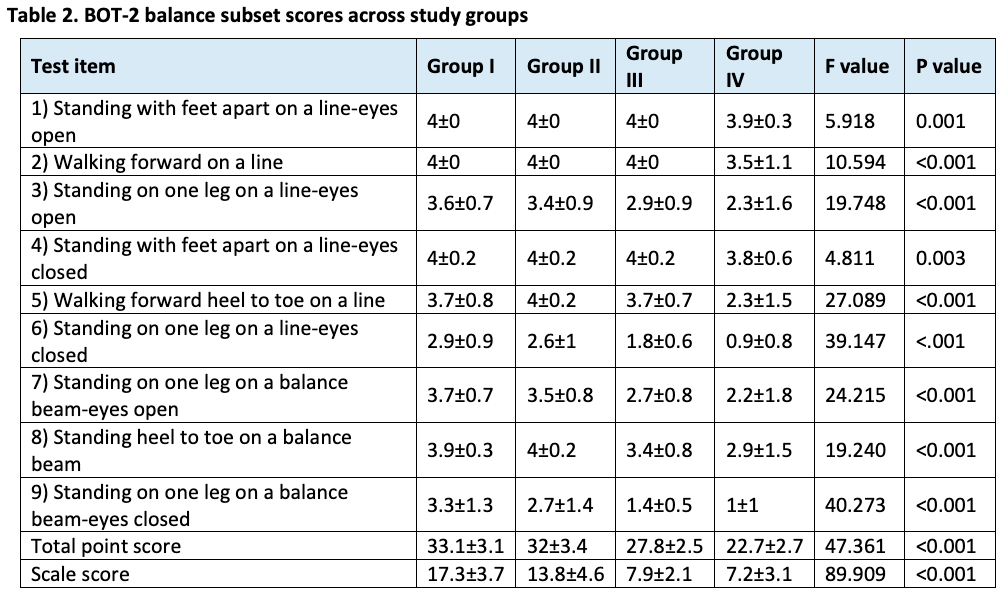
At later stages, the child may be unable to maintain balance with feet together or with eyes closed, may exhibit asymmetry in sitting position or upright posture, and may present with delayed autonomous walking, frequent falls, reliance on support, and inability to gauge step distances correctly. Table 1 shows the results of different items of the balance subset of the Bruininks-Oseretsky Test (BOT-2) in children with typical development, while Table 2 compares controls with children with sensorineural hearing loss without vestibular loss (group II), children with sensorineural hearing loss and unilateral vestibular loss (group III), and children with sensorineural hearing loss and bilateral vestibular loss (EL-Badry MM et al., 2023).
HIGH-LEVEL VESTIBULAR FUNCTIONS
AudiologyOnline: The vestibular system is often associated with balance. Does it also support higher-level functions?
Dr. Marcelli: While the aforementioned alterations seem fairly intuitive, it is essential to recall that the vestibular apparatus is actually involved in much more complex activities, referred to as high-level functions. These include the perception of accelerations, visuospatial skills, attention, spatial and body representation, as well as a modulatory effect on pain, mood, emotions, and mental activity.
AudiologyOnline: How does vestibular activity contribute to spatial navigation and spatial memory?
Dr. Marcelli: Thanks to acceleration perception and visuospatial skills, we can construct and maintain a highly precise mental representation of the world. Specifically, we can understand and organize two-dimensional and three-dimensional space, perceive distance and depth, mentally rotate images, and, above all, navigate space and build spatial memory.
Notably, spatial navigation is supported by vestibular activity, which develops this skill through direct connections to the hippocampus, mediated by the thalamus. In child development, it has been shown that spatial localization is rather rudimentary at 2 years old, a true navigation ability develops by age 7, and by age 11 this ability is similar to that of an adult, with a direct correspondence between chronological age and the increase in volume and myelination of the involved areas.
Another extremely important skill is spatial memory, which enables one to plan a route, remember where an object is located, and recall where an event occurred. It is fascinating that, thanks to spatial memory, we can process concepts such as large-small, distant-close, and above-below.
AudiologyOnline: What is the relationship between the vestibular system, body representation, and mental activity?
Dr. Marcelli: The vestibular apparatus is also involved in spatial and body representation, as demonstrated in patients with hemi-neglect or phantom limb pain. In these patients, vestibular stimulation temporarily alters this distorted representation and re-establishes correct spatial coordinates by reactivating multisensory networks.
This produces specific effects that can be seen as mechanisms through which the vestibular apparatus manages sensory signaling. By modulating other sensory modalities, vestibular inputs can thus aid in adapting flexibly to changing information in the body-world relationship and in anticipating future motor and perceptual events.
Regarding its effect on mental activity, even simply imagining rotating to the left facilitates the production of small numbers, and vice versa, or lifting facilitates addition. Similarly, thinking about the past is accompanied by a backward body movement, while thinking about the future is accompanied by a forward movement.
Therefore, the vestibular apparatus provides information about the spatial relationship between the self and the world, and space is used to structure, represent, and understand abstract concepts such as numerical magnitudes or temporal events, which cannot be directly experienced through our senses. Thus, it is unsurprising that vestibulopathy results in altered body self-awareness and cognitive disturbances.
VESTIBULAR ASSESSMENT IN AT-RISK CHILDREN
AudiologyOnline: Why is it essential to assess vestibular function in at-risk pediatric populations?
Dr. Marcelli: It is therefore extremely clear that altered vestibular development will have repercussions not only on motor function but also on learning that relies on proper visuospatial, cognitive, and memory capabilities. Hence, it is essential to assess vestibular function in at-risk children in order to initiate rehabilitative measures as quickly as possible to facilitate motor and cognitive skill acquisition.
Table 3 shows hearing loss (HL) origin and vestibular function status of candidates for cochlear implantation (Wiener-Vacher SR et al., 2024).
Table 3. Hearing loss origin and vestibular function status of candidates for cochlear implantation
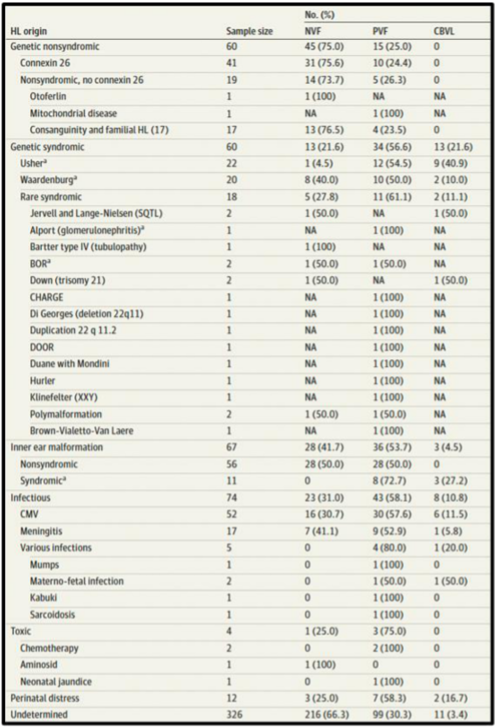
Abbreviations: BOR, branchiootorenal; CBVL, complete bilateral vestibular loss; CHARGE, involving coloboma, heart defects, atresia choanae, retardation of growth and development, genitourinary disorders, and ear anomalies; CMV, cytomegalovirus; DOOR, deafness, onychodystrophy, osteodystrophy, and mental retardation; NA, not applicable; NVF, normal vestibular function; PVF, partially impaired vestibular function; SQTL, splicing quantitative trait locus. Note that within the 67 malformations of the inner ear identified (Mondini, DAV, Gusher), 56 were isolated without any clinically associated syndrome and 11 were part of an identified syndrome: 8 Waardenburg, 1 Alport, 1 BOR, and 1 Usher type 1 syndromes.
PEDIATRIC VHIT AND REHABILITATION
AudiologyOnline: How can vestibular function be assessed in very young children?
Dr. Marcelli: In this regard, vestibular function can even be assessed in very young children through specialized equipment, such as the Inventis video head impulse test. The advantages of this method are numerous:
- Thanks to the remote camera, there is no need to wear any mask.
- The system does not require calibration.
- During the test, the child sits in a caregiver's lap while watching, for example, cartoons or images that capture their attention.
- Although it is necessary to acquire numerous trials and discard those in which the child did not focus on the target, the examination usually lasts no more than 4-5 minutes.
- The ability to study all semicircular canals, both horizontal and vertical, depends solely on the compliance of the young patient.
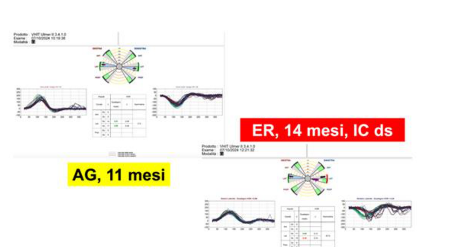
AudiologyOnline: Can you describe the pediatric cases shown in Figure 1 and how the findings may guide management?
Dr. Marcelli: In Figure 1, we see two cases of children with congenital cytomegalovirus infection. At the top left is the evaluation of the lateral semicircular canals of AG, 11 months old, whose dynamic VOR gain is normal. At the bottom right is the evaluation of the lateral semicircular canals of AG, 14 months old, with a cochlear implant on the right side. The deficit in dynamic VOR gain on the left is clearly evident.
Figure 1. Two cases of congenital cytomegalovirus infection
AudiologyOnline: What role can vestibular stimulation play in pediatric rehabilitation?
Dr. Marcelli: In this latter case, parents were advised to subject the young patient to vestibular stimulation, encouraging activities such as spinning around, swinging with both anterior-posterior and lateral accelerations, rolling on a mat, and engaging in as much physical activity as possible.
Finally, another significant aspect involves the possibility of promoting the acquisition of high-level skills by stimulating the child as previously mentioned, even in cases with a normal vestibular apparatus. In fact, as early as forty years ago, the possibility of improving conditions for children with delayed development of these skills was discussed through structured and personalized vestibular rehabilitation programs.
CONCLUSION
AudiologyOnline: What key message would you like clinicians to take away?
Dr. Marcelli: The key message is that vestibular assessment in children should not be limited to balance alone. Because vestibular function contributes to motor development, visuospatial abilities, cognition, memory, and body-world representation, early identification of vestibular alterations may help clinicians guide rehabilitation and support the acquisition of both motor and higher-level developmental skills.
RESOURCES FOR MORE INFORMATION
For more information about Inventis, visit https://www.inventis.it/en-na


Vincenzo Marcelli, MD
Dr. Marcelli holds the position of Professor at the Faculty of Medicine and Surgery, University of Naples "Federico II". For several years, he has been engaged in scientific activities as a speaker at conferences, courses, seminars, masterclasses, distance learning programs, lectures, and lessons. He is also an author of articles in scientific journals and serves as a reviewer for articles in the field of Audiology and Vestibular disorders at the local, national, and international levels.