
This comprehensive article, adapted from a webinar presentation, details the journey of Dr. Michelle Hu, a Deaf/Hard of Hearing (DHH) audiologist, and explores how assistive technology, specifically the InnoCaption app, can significantly transform communication access, particularly for phone calls. The article offers insights into the challenges faced by DHH individuals, reviews relevant assistive listening technologies, and provides actionable strategies for clinicians to empower their patients and promote self-advocacy.
Learning Outcomes
- After this course, participants will be able to list real-world challenges for deaf/hard-of-hearing (DHH) individuals, specifically on the phone.
- After this course, participants will be able to explain the benefits and functionality of assistive technologies, specifically the InnoCaption app to enhance phone calls for deaf/hard of hearing (DHH) users.
- After this course, participants will be able to provide a list of actionable strategies for promoting self-advocacy skills and provide resources to help deaf/hard-of-hearing (DHH) patients overcome communication barriers in both professional and personal situations.
Dr. Hu’s hearing loss is progressive and is a result of two syndromes: enlarged vestibular aqueduct (EVA) syndrome and Pendred syndrome. Enlarged vestibular aqueduct (EVA) syndrome is a condition where the bony canals that connect the inner ear to the brain are abnormally widened. This condition is related to progressive hearing loss. Pendred syndrome is a rare genetic disorder that can cause hearing loss and thyroid enlargement. This is also related to progressive hearing loss.
The progressive nature of the hearing loss meant that, as a child, every time Dr. Hu hit her head, her hearing would get worse, requiring hearing aids to be reprogrammed or replaced with more powerful devices. This situation caused anxiety for Dr. Hu’s parents, who felt devastated and scared, not knowing the cause or whether it was their fault. By age 10, the presenter had bilateral profound hearing loss in both ears.
The presenter discussed growing up with hearing loss requiring the use of educational support tools like FM systems and Closed Captioning. An FM System is an assistive listening device designed to improve clarity and reduce the signal-to-noise ratio. It is utilized to support auditory reception for people with hearing loss. The system often involves the teacher wearing a microphone and the student having a loop around their neck, with the sound going straight to the hearing aids or cochlear implants. It is currently also called a remote microphone system. Despite using an FM system, the presenter still missed information, especially if the teacher turned away from them while writing and talking.
Closed Captioning is time-synchronized text that reflects an audio track and can be read while watching visual content. The presenter noted that closed captioning for TV did not become widely available until the 1990s, meaning that for seven years, they watched television without knowing character names or what was being said. Cartoons, in particular, were difficult to follow.
The communication barriers created significant social challenges, leading to isolation and avoidance. The presenter avoided group situations and birthday parties due to feeling left out. The telephone was avoided for 15 to 20 years. These emotions were constant in social and communication situations. The anxiety stemmed from the fear of missing something, feeling inadequate, or needing to constantly ask for repetition. A common struggle was not wanting to ask for a speaker to repeat themselves.
The presenter described isolating themselves, staying home, and focusing on solitary hobbies. Later in life, the presenter realized they had never addressed or expressed the feeling of being different, broken, or isolated in a hearing world. They felt they were neither part of the hearing nor the Deaf community, especially when approached by peers who were excited to sign, which the presenter did not know.
Dating was also a source of anxiety, with the presenter initially trying to hide their hearing loss. This led to embarrassing situations, such as not hearing people who tried to talk to them or having an awkward moment when a hearing aid emitted feedback on a date.
Over time, the presenter realized the power in being open and advocating for their needs: "It's more empowering to share that I have a disability, that I have a hearing loss". Sharing this information often involves direct communication, such as saying, "Could you please get my attention before you start to say something," or "If it seems like I ignored you or I didn't hear you, please let me know. That's not my intention".
During college, the presenter used CART (Communication Access Realtime Translation) technology to overcome academic barriers. This service provides instantaneous transcription of spoken words into text, enabling real-time captioning for people who are deaf or hard of hearing. The transcription is often displayed on screens or devices. In a college setting, the presenter received CART services where a stenographer typed what the professor was saying, and the text appeared on a laptop. This was described as "amazing," providing access to every word and allowing the student to go back and review notes, as if a hearing person was listening and transcribing for them.
Empower DHH Patients
Clinicians can help empower Deaf and Hard of Hearing (DHH) patients by encouraging them to take charge of their communication needs.
Tips for patients:
- Share you have a hearing loss.
- Ask for attention before communication.
- Vocalize good intentions: Patients should reassure others that if they miss something, it is not intentional, and they want to know what was said.
This is part of self-advocacy, which is key to navigating the challenges of a hearing world. Audiologists play a vital role in advocating for and educating patients on available accessibility tools.
Technology Options
A significant breakthrough came later in life for Dr. Hu with advanced technology. A cochlear implant is an electronic medical device that helps people with severe to profound hearing loss hear sounds. It works by bypassing the damaged hair cells in the inner ear (cochlea) and directly stimulating the auditory nerve. The presenter learned about cochlear implants in graduate school and received her first one around age 25, despite her father having known about the technology since the patient was 10. The activation of the cochlear implant was a profound experience, likened to "a world of color," where the patient could hear soft sounds like birds chirping and fricative sounds (the /s/, /f/, and /th/ sounds) that had been missing for decades. Access to these sounds, especially the high-frequency sounds that distinguish speech, is crucial for better communication.
Phone Call Struggles
For DHH individuals, phone calls are a real struggle. This is a pervasive difficulty that clinicians should be aware of.
- Avoiding phone calls.
- Having someone else take phone calls: Relying on a spouse, partner, or family member to make or take calls.
- Phone anxiety: Anxiety associated with the high probability of missing words or needing repetition.
- Unable to communicate with the outside world: The inability to perform routine tasks like making doctor’s appointments or asking simple questions (like movie times) over the phone.
Dr. Hu avoided the telephone for 15 to 20 years, even when she became an audiologist. This led to a lack of professional follow-through, where she would ask administrative staff, co-workers, or students to make calls to insurance companies, manufacturers, or patients.
These workarounds, while providing a temporary solution, are ultimately disempowering, as they prevent the individual from having their own say, expressing their own opinions, and independently solving problems.
Key Advice
The quality of care provided by audiologists for deaf and hard-of-hearing patients strongly reflects on how well an audiologist can relate to their patients.
If more audiologists strive to relate profoundly with their patients, they could serve them that much better. When counseling patients, especially when reviewing an audiogram, the audiologist should recognize that difficulty on the phone is a major concern because of the patient’s lack of access to the high frequencies that distinguish speech.
HLAA Benefits
One recommendation for clinicians is to attend the Hearing Loss Association of America (HLAA) conference, which provides a unique perspective. Attending allows audiologists to experience what it is like to be DHH and understand the common worries and concerns. The presentations at HLAA are curated specifically for people who are deaf and hard of hearing. By understanding the patient experience, audiologists can apply their practice to help their patients better and provide more tailored care.
Caption Options
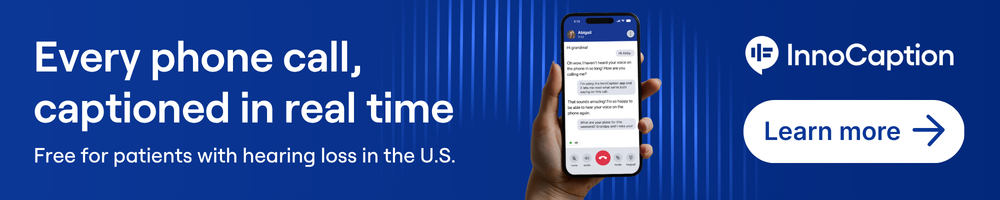
The InnoCaption application is an assistive technology that captions cell phone calls, allowing a user to read the words of the conversation in real time.
AI vs. CART: InnoCaption offers real-time captions for phone calls through either automatic speech recognition (ASR) (AI) or a live human stenographer. The user can choose between these two options. The ability to seamlessly switch between the AI and a live stenographer during a phone call is a key feature.
Stenographer Benefits: The versatility of CART providers is evident when handling heavy accents. Stenographers can also provide additional information, such as sound effects and vocal context. This is important for a user to feel more present and engaged with the conversation, for example, by knowing if there is a baby crying, background noise in a bar or restaurant, or an ambulance siren.
Outbound Caller ID
With InnoCaption, users can choose from several options to set as their caller ID: their existing cell phone number, their InnoCaption number, or no number at all. This flexibility allows the patient to use their own cell phone number for calls.
Call Forwarding
Setting up call forwarding enables the InnoCaption app to automatically pick up all incoming calls to the user’s existing cell phone number and caption them. The user also has the option to leave this feature off if they choose. This feature ensures that incoming calls are immediately accessible for captioning.
Save Transcripts
InnoCaption offers the ability to view and send past call transcripts. This feature is useful for important or personal calls that users want to save and read in the future. For example, a user can go back to a transcript to look up an address, a phone number, or a medication name.
Important Note
InnoCaption is an FCC-certified provider of relay services. As such, they are required by law to obtain certain personal information from users to prevent the misuse of this vital accessibility service for the deaf and hard-of-hearing community. This information typically includes a first name, last name, the last four digits of a Social Security number, and an address.
Self-Certification
Once the InnoCaption app is downloaded, the user selects either "I have hearing loss" or "I'm testing for someone else". The registration process does not require a signed statement from a doctor or audiologist. The user is able to self-certify their hearing loss to use the app. Audiologists do not have to send an audiogram to verify the patient's hearing loss.
No Cost to Users
InnoCaption’s service is offered free of charge to people who are deaf or hard of hearing and want to use their own voice to talk, but need assistance in understanding the other party on a call.
The service is funded and administered by the Federal Communications Commission (FCC) through the Telecommunications Relay Service (TRS) fund. It is available to eligible users in the United States. There is no subscription fee, hidden charges, or billing per minute for the user.
InnoCaption Benefits
Assistive technology like InnoCaption can significantly reduce phone anxiety and help empower patients. The app helps to remove communication barriers and promotes independence.
- Empowers patients to connect with family: The app can help users reconnect with children and grandchildren.
- Empowers patients to solve problems: It allows users to independently call banks or airline agencies and resolve issues.
- Empowers patients to be independent: It removes the disempowering dynamic of relying on a partner or spouse to make phone calls for them, enabling the user to conduct their own business.
Dr. Hu, who is DHH, found that the InnoCaption app changed their life by restoring the ability to perform a job at full capacity and ending the need to ignore or defer problems. For clinicians, it is recommended to download a demo account of the app to experience it firsthand and be able to easily explain its function to patients. Dr. Hu keeps informational brochures in her clinic that patients can scan to download the app.
Scan this QR code to request informational brochures about the InnoCaption app for your clinic.
Key Takeaways
Navigating phone calls presents a significant challenge for Deaf and Hard of Hearing (DHH) individuals, but assistive technology like InnoCaption is actively removing these barriers and fostering independence. Clinicians, particularly audiologists, are essential in this process, playing a vital role in both advocating for and educating patients about accessible communication tools. They should also strongly encourage self-advocacy, prompting patients to take charge of their own communication needs. By sharing resources such as the InnoCaption app, audiologists directly help patients overcome the difficulties of phone communication, empowering them to make calls with confidence. The ultimate mission is to help people access communication and language so they can thrive in their everyday lives.
This text course was formatted from the recorded course:
Hu, M. (2025, March 10). From silence to connection: My journey as a DHH audiologist and how InnoCaption can transform communication access [Video]. AudiologyOnline.
