
A key promise of the Widex Allure hearing aids is that they balance focus and awareness
The balance between focus and awareness is often reduced to a simple metric, the signal-to-noise ratio (SNR): What is the sound pressure level of the signal that the listener wants to focus on relative to the level of the non-signal or noise. This emphasis on SNR is an oversimplification in at least two ways: First, not all background is noise. In many situations, one sound source – often speech – may be clearly definable as the signal that the listener wants to focus on, but that does not mean that all other sounds should be categorized as noise
While it is thus clear that not all background is inherently noise, it remains important that the background is not amplified to such an extent that it overpowers the signal in focus and becomes noise. A key tool to achieving this, and a main update on the Widex Allure platform, is the Speech Enhancer Pro noise reduction
In addition to this innovation on the Allure platform, a range of legacy signal processing choices is important to the balance between focus and awareness. Among these, we have already mentioned the time-domain filter bank, which processes the sound in a way that mimics the human cochlea and keeps signal processing delay low. Another key element is the predominantly slow compression of Widex hearing aids, with its advantages of preserving the envelope of speech and the natural fluctuations of the overall sound level (see also
Method
The survey investigated the reactions of 57 experienced hearing wearers to the new Widex Allure hearing aids, in comparison to ratings of their own current hearing aids, with a focus on questions that pertain to the balance of focus and awareness in real life. The reactions to Allure were gauged after approximately three weeks of wear. The same survey participants also answered questions about their immediate reactions to Allure after approximately one week of wear; the results of that part of the survey are presented in
Respondents
The respondents were 57 experienced hearing aid wearers with bilateral hearing loss within the fitting range of the Allure M-receiver and no fluctuating hearing loss or complex ear pathologies. They were aged between 28 and 84 years (mean 67 years) and were 54% females and 46% males. They were all experienced wearers with between one and 25 years of hearing aid experience (mean 7.6 years). Their current hearing aids were a mixture of different brands and were on average three years old.
The respondents were recruited by their hearing care professionals (HCPs) with the qualification that they were interested in participating in research and able to answer online surveys on their mobile devices. They came from four different countries: The United States (49%), Canada (26%), France (19%), and the United Kingdom (5%).
Hearing Aid Fitting
Respondents were fitted with Widex Allure RIC (ARRD1) hearing aids and M-receivers, using the eartip recommended in the Compass Cloud fitting software, unless the HCP judged that a different eartip would be a better choice for the wearer. The fitting was done using the standard fitting flow in Compass Cloud, including an Acoustic Calibration. If the respondent’s hearing loss was within the fitting range of the PureSound program (the ultra-low delay program which is specifically designed to benefit listeners with mild-to-moderate hearing loss), this was added, as was a music program if the respondent was interested in that. Fine-tuning was done at the initial fitting only if the respondent indicated a need for adjustments; additional fine-tuning was done if requested during a follow-up call. In practice, just over a third (20 out of 57 respondents) had the Allure hearing aids fine-tuned. Clinical data, including the respondents’ hearing loss and the details of the fitting, were not linked to survey responses in any way.
Procedure
The survey was run in the Greenlight Guru Clinical software (www.greenlight.guru), which allows survey links to be shared with respondents via email and text messages and surveys to be answered in a secure and compliant way. Respondents were registered in the software at the fitting appointment and then answered a questionnaire about their experience with their own current hearing aids, as well as a few demographic and hearing aid experience questions. After the fitting, they were asked to wear the Allure hearing aids as they would normally wear their own hearing aids. After two to three days, they were contacted by their hearing care professional to gauge whether they were satisfied with the fitting and, if necessary, schedule a fine-tuning appointment within approximately one week. After nine days, respondents answered a relatively short questionnaire about their immediate impressions of Allure (see
Questionnaires
The questions about own current hearing aids at the beginning of the survey period and the questions about the Allure hearing aids after three weeks of wear were mostly parallel, though some preference questions only made sense at the end of the survey period and were therefore only included in the final Allure questionnaire. The questions were inspired by the design of the MarkeTrak surveys
The questions and instructions were in English in the US, UK, and Canada, while the materials for the French participants were translated to French from the English original by relevant experts.
Results
The survey included several questions concerned with backgrounds that are typically categorized as “noisy”, asking about overall satisfaction in noisy backgrounds as well as satisfaction with the use of the hearing aids specifically for conversations in noise, during transport, in restaurants, in a noisy street, and on a windy day. These are all situations where some level of noise reduction is likely to be beneficial, but, as always, this needs to be carefully balanced with awareness of surroundings. Asking about satisfaction aims to get at this balance without getting overly technical, based on the assumption that when users are satisfied with the hearing aid performance in a given situation, this is because the balance of the sound in the situation suits their needs in that situation. Satisfaction with the balance may be somewhat more driven by the ability to focus on the target signal, but also includes awareness of the surroundings.
The satisfaction ratings are shown in Figure 1, in the form of per-respondent mean ratings across the rated situations. The left half of Figure 1 is a bar chart summarizing the mean ratings for own hearing aids (light grey) and Allure (green). It shows markedly different distributions of satisfaction score categories, with Allure receiving significantly higher ratings (Wilcoxon signed-rank test: V = 1319.5, p < 0.0001). For own HAs, the scores range from “Very dissatisfied” to “Satisfied”, with the most frequent category being “Neutral” and no answers in the highest category “Very satisfied”. For Allure, by contrast, no responses are in the lowest category (“Very dissatisfied”) while more than 15% are “Very satisfied” and the most frequent category is “Satisfied”, even in this range of difficult situations.
Turning to the right panel of Figure 1, this illustrates the by-respondent difference between own HAs and Allure in the same aggregated satisfaction ratings. Although some respondents indicate higher satisfaction with own HAs, differences in favor of own hearing aids are practically always minimal, and the distribution of scores is clearly skewed to the right, indicating that a majority is more satisfied with Allure.
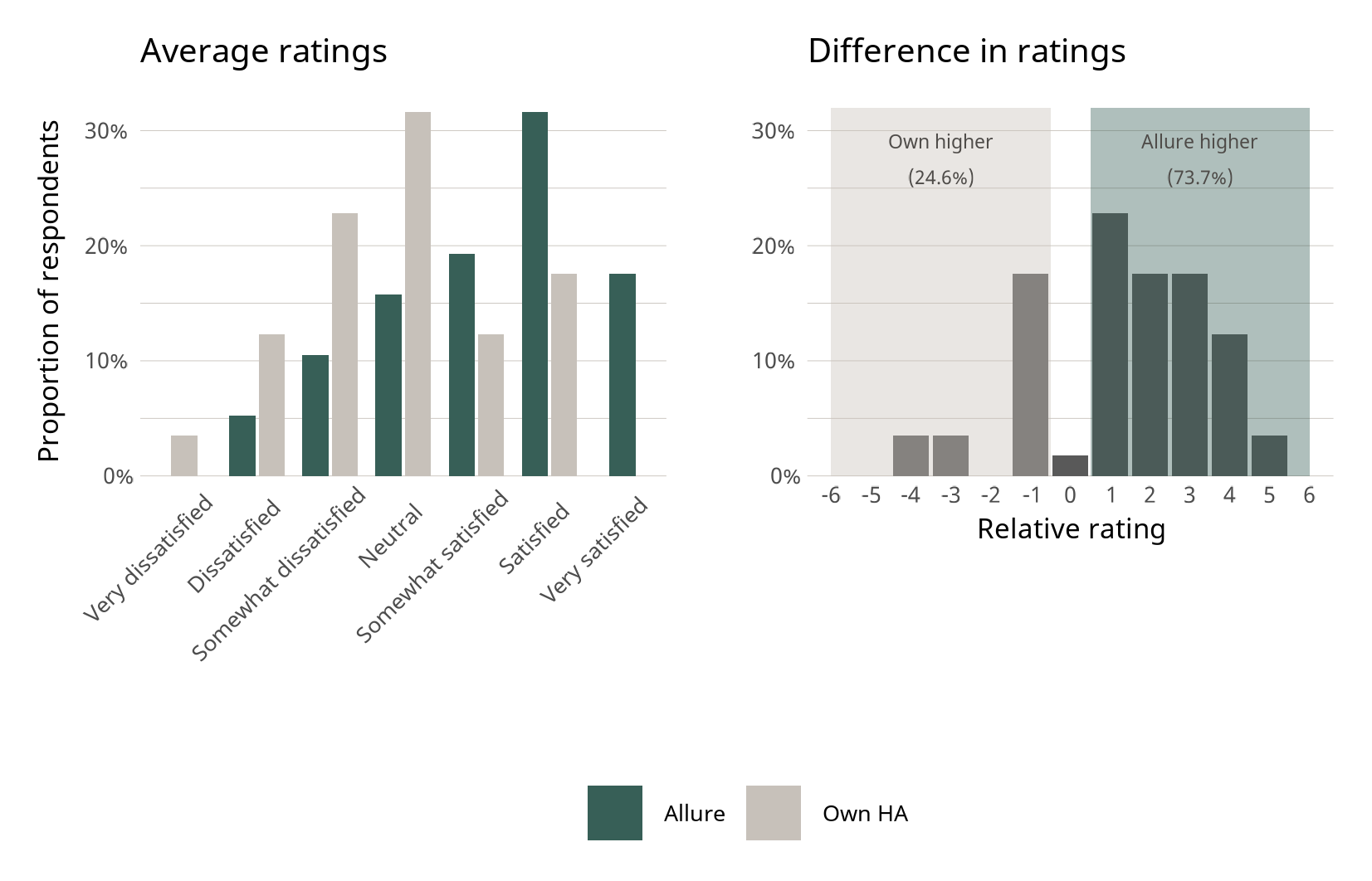
Figure 1: The figure illustrates aggregates of respondents’ ratings on six questions concerned with satisfaction in specific noisy situations and general satisfaction in noise. The left panel shows the distribution of absolute responses, where we see that while some are on average ‘Very dissatisfied’ with their own HAs, none fall into this category for Allure. In a mirror image, more than 15% are ‘Very satisfied’ with Allure, while none are ‘Very satisfied’ with their own HAs. The right panel illustrates the difference per respondent in the aggregated scores between own HAs and Allure, with negative values indicating higher satisfaction with own HAs and positive values indicating higher satisfaction with Allure. Although some respondents indicate higher satisfaction with own HAs, the majority are clearly more satisfied with Allure.
In addition to the satisfaction scores, which should broadly gauge the balance between focus and awareness, the survey also included an agreement question specifically targeting awareness: “The Widex Allure hearing aids provide me with a better awareness of the surroundings than other hearing aids I have worn in the past”. Respondents’ agreement with this statement are shown in Figure 2. Comparing the ratings obtained to a theoretical mean rating of ‘neutral’ (4 on a scale from 1 to 7) shows a highly significant effect (Wilcoxon signed-rank test V = 967.5, p < 0.0001), and in fact as many as 70% of respondents agree with the statement, with the most frequent response being ‘Strongly agree’. The fact that only 13% disagree is remarkable, because disagreement with a statement like this does not necessarily indicate a less positive experience with Allure, but could simply reflect respondents not having experienced much of a difference. Together with the high ratings of satisfaction in noisy situations, this result indicates a successful balance between focus and awareness.
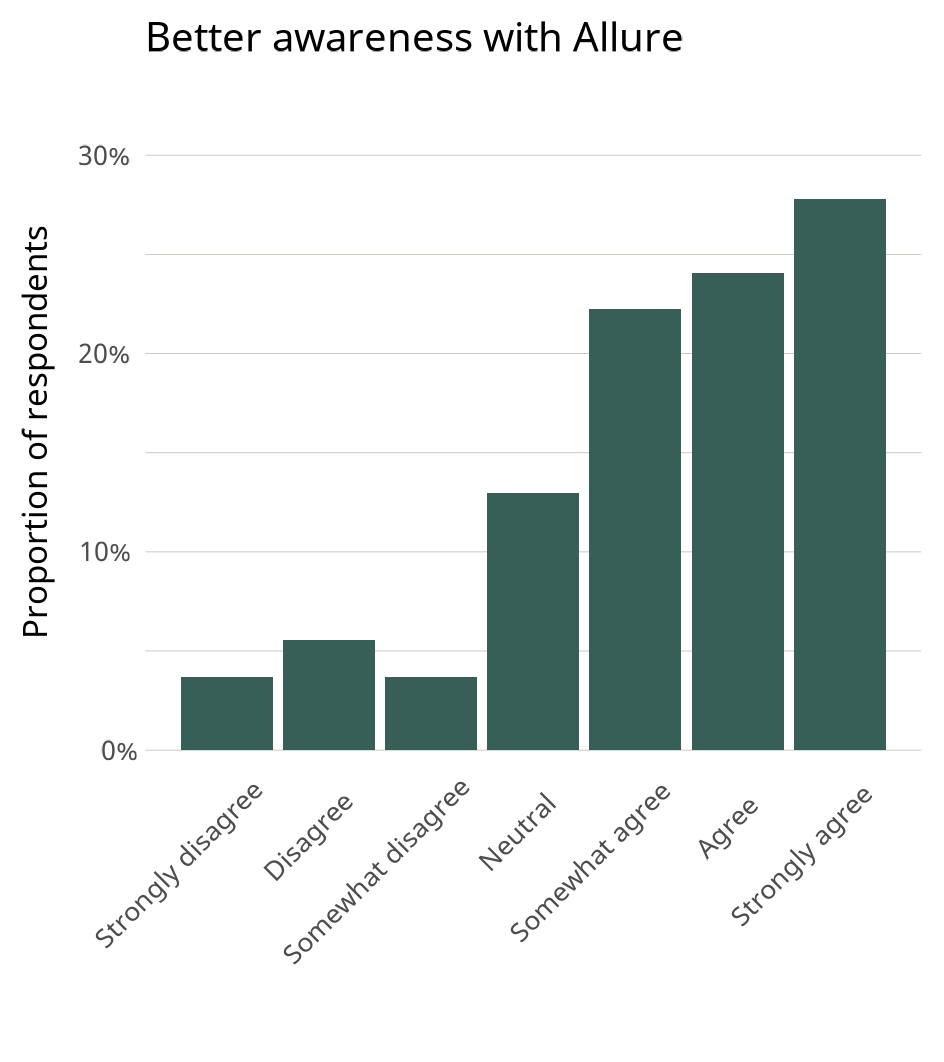
Figure 2: Respondents' agreement with the statement: The Widex Allure hearing aids provide me with a better awareness of the surroundings than other hearing aids I have worn in the past.
The third and final way that the survey assessed the performance of the Allure hearing aids was asking about preference with respect to three key areas of hearing aid experience:
- Naturalness: “In your experience, which hearing aids provide the most natural hearing experience?”
- Speech understanding: “In your experience, which hearing aids provide the best speech understanding across listening situations?”
- Sound quality: “In your experience, which hearing aids provide the best sound quality?”
Naturalness and sound quality are sometimes used interchangeably, and indeed, naturalness is to some extent a subdomain of sound quality. However, there are also good reasons to consider them separately and therefore to ask both questions. Firstly, naturalness in itself is an important component of awareness of the surroundings and of the balance between focus and awareness. Both speech and background must be represented in a natural way in order to be effortlessly recognizable. Secondly, sound quality is a much broader concept, including, at least for lay people, both fidelity of sound in a narrow sense and a range of more functional aspects, including ease of listening to the sound and ability to communicate. In this sense, the two questions on naturalness and speech understanding might be taken to both contribute to sound quality.
These questions were asked at the end of the survey, when respondents had had a little over three weeks to habituate to Allure. The results are illustrated in Figure 3, which shows that 81% of respondents indicated a preference for Allure in all three domains. Although there was considerable overlap between respondents’ preferences, 81% of respondents for the three questions are not exactly the same respondents, with seven out of 57 respondents indicating different preferences for the different questions. The Allure preference is highly significant across all three questions (binomial tests p < 0.0001), and 81% preference constitutes a strong result given that the comparison is to the respondents’ well-functioning own hearing aids.
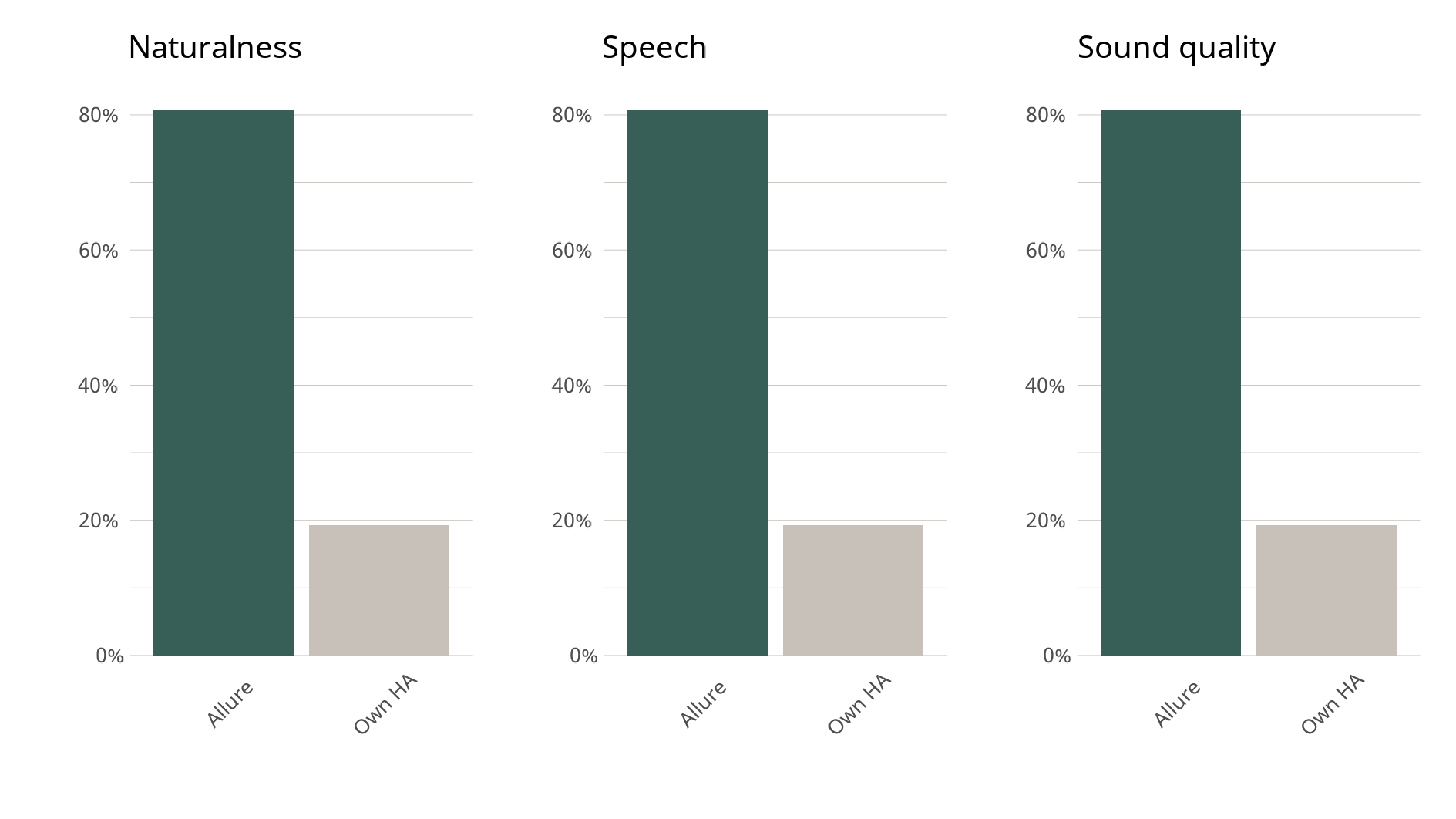
Figure 3: Respondents' indication of hearing aid preference at the end of the survey period.
Perspectives
While the sound philosophy informs the starting point for hearing aid design, and laboratory studies provide the scientifically controlled standard for assessing the effect of those design choices, real-life investigations like the one reported in this paper remain essential for verifying the effectiveness of hearing devices in everyday use. For Widex Allure, it is clear from both laboratory results
Acknowledgements
We are grateful to all participating hearing care professionals and hearing aid wearers for taking the time to test the Allure hearing aids.
References
American National Standards Institute. (1997). American National Standard: Methods for the Calculation of the Speech Intelligibility Index (ANSI S3.5-1997).
Balling, L. W., Helmink, D., Pineo, K., Philippon, B., Leung, F., & Harris, S. (2025). New Hearing Aid, New World of Hearing: First-Fit Reactions to Widex Allure. WidexPress, 57.
Balling, L. W., Mosgaard, L. D., & Helmink, D. (2022). Signal Processing and Sound Quality. Hearing Review, 29(2), 20–23.
Balling, L. W., Vormann, M., Hau, O., & Rose, S. (2025). The Superior Sound Quality of Widex Allure. WidexPress, 56.
Balling, L. W., Vormann, M., & Mansour, N. (2025). Widex Allure: A Better Speech-in-Noise Experience with Balanced Focus and Awareness. WidexPress, 55.
Balling, L. W., Vormann, M., Rose, S., & Hau, O. (2025). Widex Allure: Balancing Feedback Management with Sound Quality. AudiologyOnline, 29262.
Herrlin, P., Mansour, N., Nielsen, F., Smeds, K., & Balling, L. W. (2025). The Effect of Speech-to-Noise Ratios on Hearing Aid Noise Reduction Systems in Realistic Environments. Hearing Review.
Johnson, E. M., & Healy, E. W. (2024). The Optimal Speech-to-Background Ratio for Balancing Speech Recognition With Environmental Sound Recognition. Ear & Hearing. https://doi.org/10.1097/aud.0000000000001532
Peeters, H., Kuk, F., Lau, C., & Keenan, D. (2009). Subjective and objective measures of noise management algorithms. Journal of the American Academy of Audiology2, 20(2), 89–98.
Citation
Balling, et al. (2025). Widex Allure: Balanced Focus and Awareness In Real Life. AudiologyOnline, Article 29432. Available at www.audiologyonline.com