

- 84.1% of real-world patients with bothersome tinnitus treated with Lenire reported significant improvement.1,2
- The results are the first published of real-world patients treated with Lenire, measured using the Tinnitus Handicap Inventory (THI) and Tinnitus Functional Index (TFI).
- Patients with bothersome tinnitus reported a 25.9 (TFI) and 28-point (THI) mean reduction in tinnitus, which is nearly four times the clinically significant threshold.1,2,3
- This evidence is consistent with the first and second real-world analysis papers of U.S. tinnitus patients treated with Lenire.4,5
Boston, February 3, 2026: Real-world analysis of 97 Americans with bothersome tinnitus who were treated with Lenire, the only FDA-approved tinnitus treatment device of its kind, has been made available on medRxiv, a preprint server for health sciences.
Results in the paper titled: “First Real-World Evidence Utilizing the Multidimensional Tinnitus Functional Index to Assess Treatment Impact with Bimodal Neuromodulation” reported 84.1% of patients with bothersome tinnitus had a clinically significant reduction in tinnitus when treated with Lenire.1,2
- Read the paper: https://www.medrxiv.org/content/10.64898/2026.01.20.26344445v1
These are the first results published from patients treated with Lenire in a real-world clinical setting that are measured using both the Tinnitus Functional Index (TFI) and the Tinnitus Handicap Inventory (THI).
The TFI and THI are the two most commonly used outcome measures in clinical practice for tinnitus. 84.1% of patients reported significant relief as measured by THI, and 73.4% reported significant relief as measured by TFI, demonstrating a strong correlation between the two measures and positive treatment outcomes for Lenire patients regardless of outcome measure used.
The paper, authored by Dr. Brian Fligor Ph.D and Dr. Miles Sabine, Au.D, of Tobias & Battite Hearing Wellness, analyzed the results of 97 patients with bothersome tinnitus who were fitted with Lenire between May 19, 2023, and February 29, 2024.
Tinnitus is commonly known as ringing in the ears, but can manifest as hissing, buzzing, and other persistent sounds. The condition afflicts an estimated 25 million American adults, with up to 1.75 million tinnitus patients living in Massachusetts alone.6
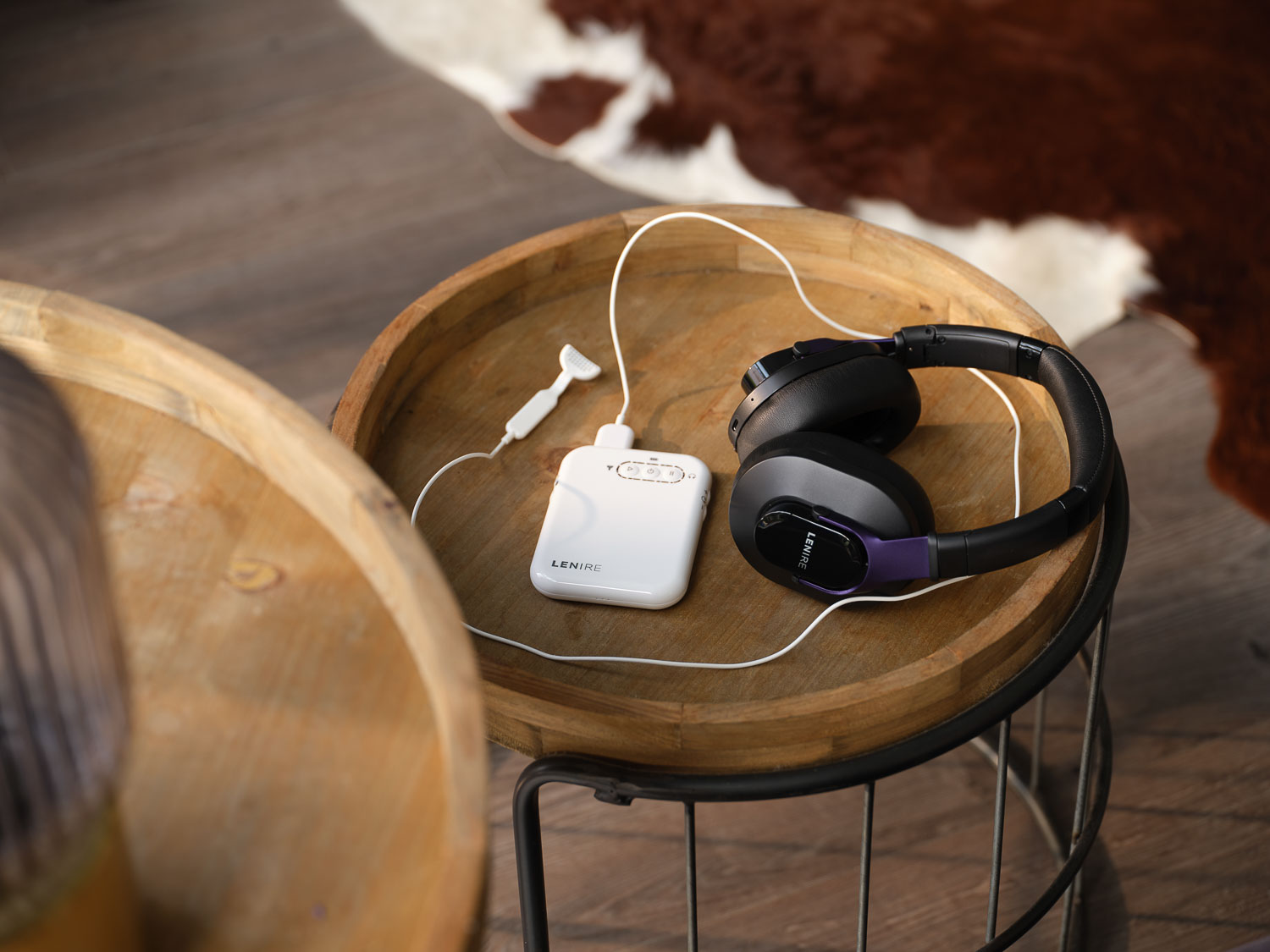
Lenire uses bimodal neuromodulation and is clinically proven to effectively treat tinnitus. Bimodal neuromodulation is the simultaneous stimulation of two nerves for therapeutic purposes. Lenire plays audio tones via headphones while delivering mild pulses to the surface of the tongue to treat tinnitus. Under the care of an audiologist with tinnitus expertise, patients typically use the device at home for two 30-minute sessions daily for approximately 12 weeks.
Consistent, Repeatable, Broadly Measurable Results
This paper is the third in a series of planned, real-world evidence publications that have been compiled from thousands of U.S. tinnitus patients who have been successfully treated with Lenire.
The analysis found that at the interim check-up, after six weeks of treatment with Lenire, 80.3% of patients with bothersome tinnitus had a clinically meaningful reduction in tinnitus.1,2 After 12-weeks, 84.1% of patients with bothersome tinnitus had a clinically meaningful reduction.1,2 73.4% of patients reported significant relief as measured by the TFI (including a significant decrease in the loudness of their tinnitus), indicating a strong correlation between THI and TFI treatment outcome measures.1,3
Patients with bothersome tinnitus reported a 25.9 (TFI) and 28-point (THI) mean reduction in tinnitus, which is nearly four times the clinically significant threshold.1,2,3 The majority of patients with bothersome tinnitus reported they were no longer severely impacted by their tinnitus following 12-weeks of Lenire, according to tinnitus severity grading guidelines.1,2,3,11,12
These results are consistent with previous real-world analyses of tinnitus patients treated with Lenire and demonstrate repeatable, multi-scale success for tinnitus patients in real-world clinical settings across multiple tinnitus measurement methodologies.
“Tobias & Battite Hearing Wellness is making the latest treatment interventions backed by credible data available to our patients and working with them to get the best treatment outcomes, and identify new ways to improve clinical best practices,” said Tobias & Battite Hearing Wellness audiologist-in-chief and owner, Dr. Brian Fligor, Ph. D. “This research underscores not just the proven effectiveness of Lenire, but also the important relationship between a hearing care professional and their patients.”
In addition to being supported by the largest body of clinical trial data in its field, Lenire is now underpinned by the most extensive real-world evidence of safety and effectiveness following the availability of this research, and peer-reviewed analysis papers published in Nature Portfolio4 and The American Journal of Audiology5.
The first real-world analysis of U.S. patients treated with Lenire, which was peer-reviewed and published in Nature Communications Medicine, showed that 91.5% of bothersome tinnitus patients who used Lenire had a clinically significant reduction in tinnitus.4 The second real-world analysis of U.S. patients treated with Lenire, which was peer-reviewed and published in the American Journal of Audiology, showed 81.8% of patients with bothersome tinnitus had clinically significant relief from tinnitus.5 This consistency further demonstrates the effectiveness of a typical treatment protocol with Lenire in a real-world clinical setting.
Real World Outcomes Consistent with Clinical Trials
FDA Approval in March 2023 was facilitated by Lenire’s controlled, TENT-A3 clinical trial. The results were published in Nature Communications, a journal from the same portfolio. The paper remains in the 99th percentile of more than 250,000 tracked Nature articles.
TENT-A3 included 112 trial participants and demonstrated Lenire’s clinical superiority to sound-only therapy, a widely used treatment for tinnitus. Nearly 89% of trial participants said they would recommend Lenire as a tinnitus treatment.7
According to Neuromod Devices founder and CEO, Dr. Ross O’Neill, “Across three papers, we are seeing consistent real-world outcomes that continue to demonstrate the replicability and scalability of Lenire as a treatment option for tinnitus patients, who are a growing and underserved patient population.”
“Analysis conducted by Tobias & Battite Hearing Wellness that publishes positive patient results using the TFI scale further demonstrates Lenire’s market-surpassing treatment effectiveness and positions Lenire as a leading standard of care for tinnitus patients.”
Lenire is available through specialized tinnitus clinics in the United States of America and Europe. Lenire is also a treatment option through the US Department of Veterans Affairs.''
References and Notes
- Fligor, B, and Sabine, M. First Real-World Evidence Utilizing the Multidimensional Tinnitus Functional Index to Assess Treatment Impact with Bimodal Neuromodulation, https://doi.org/10.64898/2026.01.20.26344445 (2026)
- As measured by Tinnitus Handicap Inventory (THI). THI is the most widely used clinical standard for measuring the impact of tinnitus on someone’s day-to-day life. The THI is a validated instrument that is measured on a scale of 100, the higher the score, the greater the impact of tinnitus.
- Gos E, et al. How to Interpret Tinnitus Functional Index Scores: A Proposal for a Grading System Based on a Large Sample of Tinnitus Patients. Ear Hear. 2021 May/Jun;42(3):654-661. doi: https://doi.org/10.1097/aud.0000000000000967.
- Mc Mahan, E., and Lim, H. Retrospective chart review demonstrating effectiveness of bimodal neuromodulation for tinnitus treatment in a clinical setting. Commun Med (2025). https://doi.org/10.1038/s43856-025-00837-3
- Kasper, C. et al. Bimodal Neuromodulation for Tinnitus in a Clinical Practice Setting: Clinically Significant Benefit for Patients with Moderate or Worse Symptoms, American Journal of Audiology, https://doi.org/10.1044/2025_AJA-25-00090 (2025) 6. https://www.nidcd.nih.gov/health/tinnitus
- Boedts, M. Beuchner, A. et al. Combining sound with tongue stimulation for the treatment of tinnitus: a multi-site single-arm controlled pivotal trial. Nature Communications (2024)
- Conlon et al., Sci. Transl. Med. 12, eabb2830 (2020)
- Conlon et al., Different bimodal neuromodulation settings reduce tinnitus symptoms in a large randomized trial, Sci Rep.
- US VA Benefits Report Fiscal Year 2024: https://www.benefits.va.gov/REPORTS/abr/
- Zeman, F. et al, Tinnitus handicap inventory for evaluating treatment effects: which changes are clinically relevant? https://pubmed.ncbi.nlm.nih.gov/21493265/ (2011) Clinically meaningful reduction in tinnitus is defined as at least 7-points of improvement on the THI scale for the paper.
- A. McCombe et al., Guidelines for the grading of tinnitus severity, Clin. Otolaryngol. 2001, 26, 388 - 393
