

- 81.8% of patients with bothersome tinnitus treated with Lenire at New York Hearing Doctors reported significant improvement in a real-world clinical setting.1,2
- Patients with bothersome tinnitus reported a 23.8-point mean reduction in tinnitus as measured by the Tinnitus Handicap Inventory, which is greater than three times the threshold for clinical significance.1,2
- The majority of patients with bothersome tinnitus reported they were no longer severely impacted by their tinnitus following 12-weeks of Lenire.1,2
This evidence is consistent with the first real-world analysis of U.S. tinnitus patients treated with Lenire that was peer-reviewed and published in Nature Communications Medicine.3
New York, January 13, 2025: The American Journal of Audiology has peer-reviewed and published the positive outcomes of U.S. tinnitus patients treated with Lenire, the only FDA-approved tinnitus treatment device of its kind.
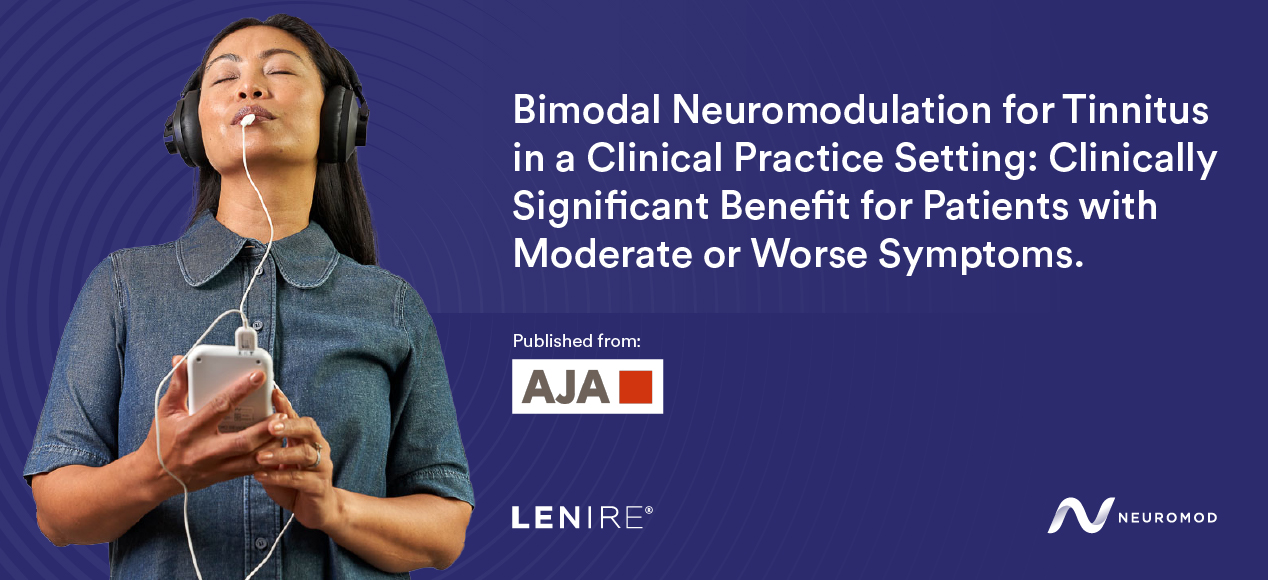
Results in the paper titled: “Bimodal Neuromodulation for Tinnitus in a Clinical Practice Setting: Clinically Significant Benefit for Patients with Moderate or Worse Symptoms” reported 81.8% of patients with bothersome tinnitus had a clinically significant reduction in tinnitus when treated with Lenire.1,2
These results are consistent with previously published Lenire treatment outcomes3, showing repeatable success for tinnitus patients in real-world clinical settings. In addition to being supported by the largest body of clinical trial data in its field, Lenire is now underpinned by the most extensive real-world evidence of safety and effectiveness, following publication of this research in The American Journal of Audiology.
The paper, authored by Dr. Craig Kasper Au.D of New York Hearing Doctors (NYHD) et al, analyzed the results of 140 tinnitus patients who were fitted with Lenire at NYHD between May 1, 2023, and January 19, 2024.
Tinnitus is commonly known as ringing in the ears, but can manifest as hissing, buzzing, and other persistent sounds. The condition afflicts an estimated 25 million American adults4, with an estimated 2.5 million tinnitus patients living in New York alone.5
Lenire uses bimodal neuromodulation to treat tinnitus. Bimodal neuromodulation is the simultaneous stimulation of two nerves for therapeutic purposes. Lenire plays audio tones via headphones while delivering mild energy pulses to the surface of the tongue to treat tinnitus. Under the care of an audiologist with tinnitus expertise, patients with bothersome tinnitus typically use the device at home for two 30-minute sessions daily for approximately 12 weeks.
Results Consistent with Real World Research and Clinical Trials
This paper is the second in a series of planned, real-world evidence publications that have been compiled from thousands of U.S. tinnitus patients who have been successfully treated with Lenire.
The analysis found that at the interim check-up, after six weeks of treatment with Lenire, 72.6 percent of patients with bothersome tinnitus had a clinically meaningful reduction in tinnitus.1,2 After 12-weeks, 81.8% of patients with bothersome tinnitus had a clinically meaningful reduction.1,2
Patients reported a mean reduction of 23.8 points on the Tinnitus Handicap Inventory (THI) after 12-weeks, greater than three times the threshold for clinically significant reduction.1,2 As a result, the majority of patients with bothersome tinnitus reported they were no longer severely impacted by their tinnitus following 12-weeks of Lenire, according to tinnitus severity grading guidelines. 1,2, 11
“New York Hearing Doctors stay on the cutting-edge of tinnitus care through the introduction of modern technologies like Lenire and leveraging research to consistently refine our treatment methodologies," said NYHD founder, Dr. Craig Kasper, Au. D. “The combination of our personalized approach to tinnitus care and the remarkable effectiveness of Lenire, we are seeing life-changing treatment outcomes for our patients.”
“Lenire was nothing less than a game-changer in my life. I went from debilitating, almost catastrophic tinnitus that required medication to treat the depression and anxiety, to being able to enjoy life again after four months of Lenire,” said Richard Bistrong, tinnitus patient at New York Hearing Doctors. “Three years later, I can enjoy my life and not worry about my tinnitus. This has impacted not only my well-being but my loved ones as well. For anyone who is looking for relief, that is based in science and patient results, I would encourage you to seek your local Lenire Provider as soon as possible to learn more about Lenire."
The evidence in this paper is consistent with the first peer-reviewed real-world analysis of U.S. tinnitus patients treated with Lenire and Lenire’s large-scale clinical trials.3,6,7,8
The first real-world analysis of U.S. patients treated with Lenire, which was peer-reviewed and published in Nature Communications Medicine, showed that 91.5% who used Lenire had a clinically significant reduction in tinnitus after 12-weeks of Lenire.3 This consistency demonstrates the effectiveness of a typical treatment protocol with Lenire in a real-world clinical setting.
FDA Approval in March 2023 was facilitated by Lenire’s controlled, TENT-A3 clinical trial. The results were published in Nature Communications, a journal from the same portfolio. The paper remains in the 99th percentile of more than 250,000 tracked Nature articles.
TENT-A3 included 112 trial participants and demonstrated Lenire’s clinical superiority to sound-only therapy, a widely used treatment for tinnitus. Nearly 89% of trial participants said they would recommend Lenire as a tinnitus treatment.6
According to Neuromod Devices founder and CEO, Dr. Ross O’Neill, who was Lenire’s principal inventor, “The consistency of the real-world outcomes of US tinnitus patients treated with Lenire with our large-scale clinical trials demonstrates the replicability and scalability of Lenire as a tinnitus treatment option for the over 740 million people worldwide living with tinnitus.”
“By working closely with our network of providers, we are seeing market-surpassing patient outcomes, improving clinical best practices, and a rapidly growing body of robust real-world evidence positioning Lenire and bimodal neuromodulation as a leading tinnitus treatment option.”
Lenire is available through specialized tinnitus clinics in the United States of America and Europe. Lenire is also a treatment option through the US Department of Veterans Affairs.
References and Notes
Kasper, C. et al. Bimodal Neuromodulation for Tinnitus in a Clinical Practice Setting: Clinically Significant Benefit for Patients with Moderate or Worse Symptoms, American Journal of Audiology, https://doi.org/10.1044/2025_AJA-25-00090 (2025)
As measured by Tinnitus Handicap Inventory (THI). THI is the most widely used clinical standard for measuring the impact of tinnitus on someone’s day-to-day life. The THI is a validated instrument that is measured on a scale of 100; the higher the score, the greater the impact of tinnitus. THI scores are categorized into five severity levels: slight, mild, moderate, severe, and catastrophic. Patients who are at least moderately affected by their tinnitus have a THI score of 38 and above and fall into the moderate, severe and catastrophic categories.
Mc Mahan, E., and Lim, H. Retrospective chart review demonstrating effectiveness of bimodal neuromodulation for tinnitus treatment in a clinical setting Commun Med (2025). https://doi.org/10.1038/s43856-025-00837-3
https://www.nidcd.nih.gov/health/tinnitus
https://www.nyc.gov/assets/doh/downloads/pdf/survey/survey-2013noise.pdf
Boedts, M. Beuchner, A. et al. Combining sound with tongue stimulation for the treatment of tinnitus: a multi-site single-arm controlled pivotal trial. Nature communications (2024)
Conlon et al., Sci. Transl. Med. 12, eabb2830 (2020)
Conlon et al., Different bimodal neuromodulation settings reduce tinnitus symptoms in a large randomized trial, Sci Rep.
US VA Benefits Report Fiscal Year 2024: https://www.benefits.va.gov/REPORTS/abr/
Zeman, F. et al, Tinnitus handicap inventory for evaluating treatment effects: which changes are clinically relevant? https://pubmed.ncbi.nlm.nih.gov/21493265/ (2011) Clinically meaningful reduction in tinnitus is defined as at least 7-points of improvement on the THI scale for the paper.
A. McCombe et al., Guidelines for the grading of tinnitus severity, Clin. Otolaryngol. 2001, 26, 388 - 393
