
Question
How does OpenSound Navigator work?
Answer
There are three very important details that set apart the design of OpenSound Navigator from more traditional directionality and more traditional noise reduction systems.
- Analysis phase
- Noise removal phase receives information from the analysis phase
- Update speed
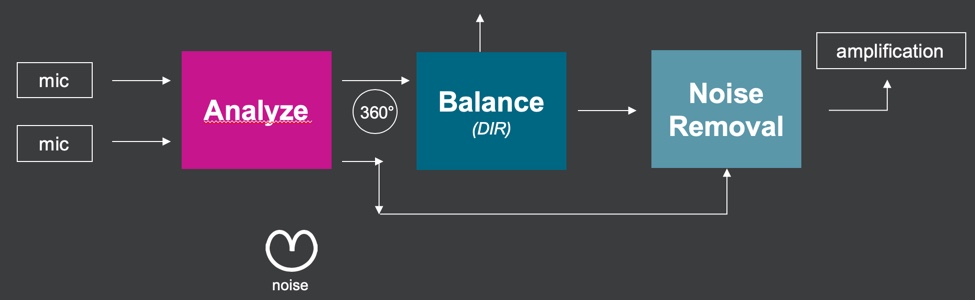
Analysis Phase
The first technical difference is this analysis block. What ends up happening in the analysis block is that we take in a lot of information about the environment in a unique way before we allow directionality or noise removal to do anything to the signal. This is very unique compared to more traditional systems. In most traditional systems, you'd go right from the microphone input directly into the directionality, and then directionality would do whatever directionality is going to do and hand over whatever's left as signal to the noise removal system. Once the noise removal system played its part, the signal would go on to the non-linear compressor. That's the way most modern high-end hearing aids are designed. What they were missing is this analysis block.
The unique thing about the analysis block is that we are evaluating the environment using the power of two microphones to take a look at the environment using both a 360-degree or an omnidirectional look at the environment, as well as a backwards-facing look at the environment. In other words, we use the directional microphones to create a backwards facing polar plot. Part of the analysis is to compare the noise in the general environment with what's happening directly behind the patient. With a good amount of signal massaging and signal processing laid on top of these analyses, that allows both the directionality function and the noise reduction function to be much more targeted in terms of how it attacks the environment.
Noise Removal Phase
The second unique aspect about the way OpenSound Navigator is designed is that the noise removal section gets location information from the analysis block. In most traditional designs, the first thing that happens is directionality. After directionality has done whatever it can to clean up the signal, it hands over that signal to noise removal, but there's no directional information left over. The noise reduction in traditional hearing aids just has to work on that signal without any knowledge about where those sounds came from.
With OpenSound Navigator, we route information that we glean in this analysis function by comparing the 360 degree look at the environment with this backwards facing look at the environment to tell the noise removal system about the location of sounds, as well as which sounds are more likely to be speech-like and which are less likely to be speech-like. One of the reasons why our noise removal system is more effective than traditional systems in the marketplace (including traditional systems that we've used in the past) is that it's spatially aware. In other words, it knows more about the environment than traditional noise removal systems. During the analysis function, we're capturing a lot of information. We capture the frequency (because we're doing 16 channels of analysis), the level at which sounds are occurring, the location from which sounds are coming, and an analysis of whether sounds contain speech or non-speech information. That analysis block is feeding forward a lot of information to both the directionality and the noise removal sections in order for them to do their job.
Update Speed
The third important difference between OpenSound Navigator and traditional noise reduction and directionality systems in the marketplace is the update speed at which we operate. When we created OpenSound Navigator, we created it on a new platform back in 2016 called the Velox platform. More recently, we have updated that platform, and now we're on the Velox S platform. When we released on the Velox platform, we massively increased the processing resources available on that platform. Because we have those processing resources, we are able to implement OpenSound Navigator. One of the most important aspects to make OpenSound Navigator as effective as it has been proven to be is the ability to work at a very fast pace. The update speeds on OpenSound Navigator are 100 times per second (updates every 10 milliseconds). The update speeds on traditional noise reduction and directionality are typically measured in seconds. Oftentimes, you can see update speeds on the order of three seconds, and even five or 10 seconds or longer. This difference in pure horsepower at which this system is running is a big part of what drives the success of OpenSound Navigator.
This Ask the Expert is an excerpt from The Behavior of OpenSound Navigator in Complex Environments. Learn more on the Oticon Expo Page on AudiologyOnline.
Continued and its subsidiaries provide professional education authored by qualified Subject Matter Experts for continuing education purposes. These materials are intended for educational purposes and do not constitute medical advice or a substitute for individual clinical judgment. Continued is not a clinical healthcare provider; the licensed professional is solely responsible for ensuring that the application of any techniques or information presented is within their legal scope of practice and jurisdictional requirements.