
AudiologyOnline Phone: 800-753-2160


Oticon Medical Sentio - July 2024

What Are the Differences Between Direct Drive vs. Skin Drive?

Joanne Restivo, AuD, CCC-A

June 10, 2019

Share:

Question

What are the differences between Direct Drive vs. Skin Drive?

Answer

From a performance perspective, bone anchored systems can be classified into two groups: direct drive (percutaneous) transmission options and skin drive (transcutaneous) transmission options.

As shown in Figure 1, there is significantly more output provided with a direct drive system (represented by the orange color) as compared to the skin drive (shown in yellow). The direct drive allows for increased low frequencies, for better loudness sensation and voice quality, more high frequencies for delivery of important speech signals, and also a wider frequency bandwidth for improved speech perception, sound quality, and speech in noise understanding.
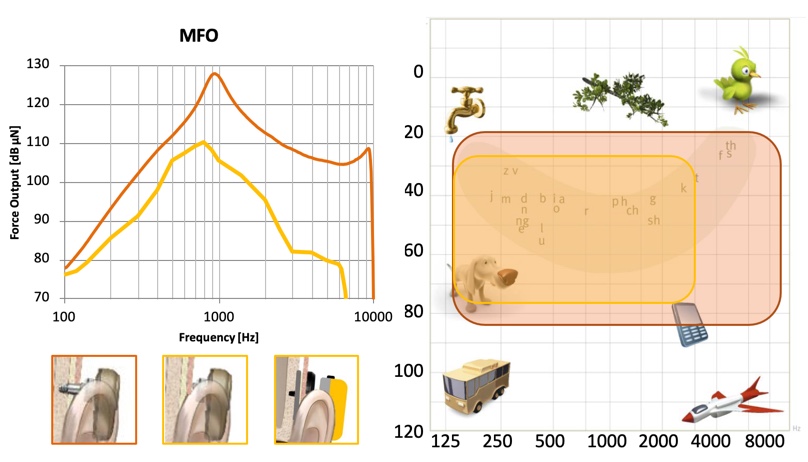
Direct drive versus skin drive

Figure 1. Direct drive vs. skin drive.

Some benefits of direct sound transmission are that:

  • Sounds are attenuated in skin transmission solutions, even with softband correction factors in the software.
  • Direct sound transmission systems can provide an extra 10 to 20 dB of output in the mid to high-frequency range.
  • The mid and high-frequency range contains the most important sound information for speech understanding.

There are some additional differences between percutaneous and transcutaneous systems.

  • Direct-drive systems send vibrations via a direct route to the bone. With skin drives (such as softband, headband, test band or passive transcutaneous solutions with an implanted magnet), vibrations are sent through the skin and tissue to the bone. This suffers from skin and tissue attenuation. 
  • There is a minimal physical sensation of the device when the patient is wearing a direct drive system. With skin drives, there is a constant awareness of the processor due to the pressure it puts on the skin. 
  • With direct drives, MRI shadowing is nominal, producing about a 10-millimeter artifact. In contrast, with skin drives, MRI shadowing is significant, producing about a 150-millimeter artifact. This is important to consider when we are working with patients that may require MRIs. 
  • With direct drive systems, tissue preservation surgery leaves only a small post. With skin drives, surgery removes a significant area of hair, skin, and tissue (if you're using a magnetic option).

Another benefit of direct drive systems is that they offer upgradability, regardless of the possible changes in hearing.

In terms of transmission, direct drive devices are the most efficient, since no attenuation occurs from the skin and tissue dampening. A person who uses a skin drive system, due to their limited output, is at risk of missing important speech sounds. The skin and tissue absorb the energy causing a lower perceived output level. More power is needed in order to have the same perceived benefit with a skin drive device when compared to a direct drive device.

This Ask the Expert is an excerpt from the CE Course, Power for Everyone!


joanne restivo

Joanne Restivo, AuD, CCC-A

Joanne Restivo has been an audiologist since 2007. Joanne received her Master of Science (M.S.) degree in Audiology at Adelphi University, followed by her Doctor of Audiology (Au.D.) degree from University of Florida in 2009. Joanne started her career with Oticon Medical in July of 2018. Prior to that Joanne worked as a Professional Education Manager for a hearing aid manufacturer. Clinically, Joanne worked at both Columbia University Medical Center in New York and then at Providence Speech and Hearing Center in California. Her clinical focus was in pediatric audiology; working with cochlear implants and bone anchored devices. Joanne has also done humanitarian work, volunteering in Vietnam with the Foundation for Children with Hearing Loss in 2011.


Related Courses

Bone Conduction Hearing Devices (BCHD): Clinical and Surgical Considerations in Pediatrics
Presented by Laurie Mauro, AuD, CCC-A
Recorded Webinar
Oticon Medical

Presenter

Laurie Mauro, AuD, CCC-A
Course: #36632Level: Intermediate1 Hour
  'Very concise and thoughtful presentation'   Read Reviews
This course will provide information on clinical considerations for Bone Conduction Hearing Devices (BCHDs) in the pediatric population. Both non-surgical and surgical options will be discussed with a focus on transitioning patients from a softband to surgical BCHD.

View this Course for FREE.
Need CEUs? Become a AudiologyOnline member to get unlimited CEUs.

Only $129/yr

Learn More

Beyond Hearing: Exploring Candidacy Through Cases
Presented by Hilary McManus, AuD, Rebecca Chiffer, MD
Recorded Webinar
Oticon Medical

Presenters

Hilary McManus, AuDRebecca Chiffer, MD
Course: #39712Level: Intermediate1 Hour
  'I am just starting with BAHA and this was an excellent intro to how surgery can be completed'   Read Reviews
This course covers the audiological and surgical criteria for Ponto implant candidacy, including detailed examination of surgical eligibility. Participants delve into intriguing Ponto surgery cases, alongside a comprehensive review of surgical techniques and procedures.

View this Course for FREE.
Need CEUs? Become a AudiologyOnline member to get unlimited CEUs.

Only $129/yr

Learn More

Path to Ponto: Incorporating Bone Anchored Hearing Systems Into Private Practice Audiology Clinics
Presented by Dianna Tingle Gould, AuD
Recorded Webinar
Oticon Medical

Presenter

Dianna Tingle Gould, AuD
Course: #38706Level: Introductory1 Hour
  'Organized clear content with excellent visual slides, covered information beneficial to patients in our clinic'   Read Reviews
This course will aim to provide audiologists in a private practice setting with the tools and resources necessary to provide access and continued support within the ever-evolving private practice.

View this Course for FREE.
Need CEUs? Become a AudiologyOnline member to get unlimited CEUs.

Only $129/yr

Learn More

Joining the Path to Ponto
Presented by Lisa Reedy, AuD
Recorded Webinar
Oticon Medical

Presenter

Lisa Reedy, AuD
Course: #39230Level: Introductory1 Hour
  'Good info about Ponto'   Read Reviews
This course provides the opportunity to learn the basics of bone anchored hearing systems including the Oticon Medical Ponto and how to start working with Oticon Medical.

View this Course for FREE.
Need CEUs? Become a AudiologyOnline member to get unlimited CEUs.

Only $129/yr

Learn More

Ponto 5 SuperPower - New Clinical Data
Presented by Julie Neel Weile
Recorded Webinar
Oticon Medical

Presenter

Julie Neel Weile
Course: #38467Level: Introductory0.5 Hours
  'Good data, well organized presentation'   Read Reviews
This course will introduce new clinical evidence supporting the most powerful abutment level superpower device--Ponto 5 Superpower--and discuss device parameters to consider in BAHS fittings. Patient data involving understanding speech-in-noise and patient preference will be discussed in this course.

View this Course for FREE.
Need CEUs? Become a AudiologyOnline member to get unlimited CEUs.

Only $129/yr

Learn More

Our site uses cookies to improve your experience. By using our site, you agree to our Privacy Policy.