
Question
What are the roles of Bellman & Symfon alerting devices?
Answer
Bellman & Symfon positions its personal amplifiers and alerting devices as a complement to a practice and to hearing aids, not as competitors. The company aims to provide a total hearing solution by offering a wide portfolio that includes personal amplifiers and alerting devices. Personal amplifiers offer an alternative for the cost-conscious patient or for patients who have too much difficulty handling or frequently losing hearing aids. They can also serve as a natural segue into hearing aids when a patient is ready. These devices are useful for inpatient communication (such as in senior living or hospitals), fulfilling ADA requirements, and serving as assistive devices for providers to communicate with patients during assessment and product selection. Furthermore, Bellman & Symfon's alerting and notification systems address patient concerns about safety, independence, and the growing field of Remote Patient Monitoring (RPM).
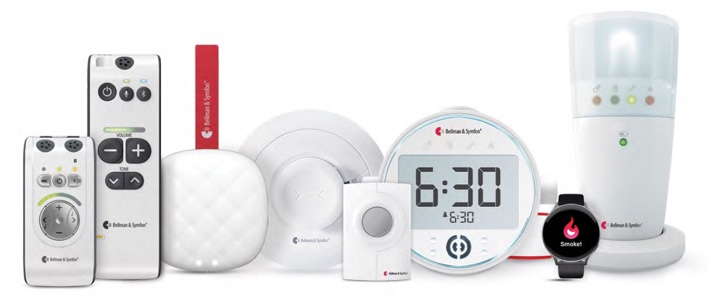
Figure 1: Bellman & Symfon Alerting and Notification Systems, which comprise transmitters (like smoke alarm, door, phone, and push button) and receivers (like a flash, alarm clock, and watch) to offer a whole-house solution.
Integrating Bellman & Symfon's assisted listening devices (ALDs) and notification systems into a hearing care practice involves updating workflows and asking specific questions to gain a holistic view of the patient's needs. Providers can incorporate questions into intake forms that measure the impact of hearing on a patient's independence, safety within their surroundings, ability to hear alerts, and capacity to provide or receive care. These questions, often rated on a scale of 1-10, can establish a measurable baseline to compare against subsequent follow-up appointments, such as at the six-month mark. Providers can also integrate these products through physician marketing, community outreach, and by introducing the options at a patient's six-month check-up.
The personal amplifiers themselves feature modern innovations that set them apart from older ALDs (Assistive Listening Devices). For instance, the Maxi Pro includes Bluetooth capabilities. The Mino and Domino Pro feature a directional microphone that the patient can toggle on or off. All three personal amplifiers utilize digital signal processing (DSP), which helps provide a more clear and comfortable understanding of sound for the patient by incorporating features like 10-band noise cancellation, 10-band dynamic compression, and adaptive feedback cancellation. These features are key advancements in ALD technology.

Figure 2: The Mino Personal Amplifier, an example of a Bellman & Symfon personal amplifier, featuring easy-to-use controls and modern DSP technology.
This Ask the Expert is an edited excerpt from the course, Sable-Antry, S. (2025, September 9). Not your grandpa's ALD's. AudiologyOnline. https://www.audiologyonline.com/audiology-ceus/course/not-your-grandpa-assistive-listening-41205
Continued and its subsidiaries provide professional education authored by qualified Subject Matter Experts for continuing education purposes. These materials are intended for educational purposes and do not constitute medical advice or a substitute for individual clinical judgment. Continued is not a clinical healthcare provider; the licensed professional is solely responsible for ensuring that the application of any techniques or information presented is within their legal scope of practice and jurisdictional requirements.