

AudiologyOnline Phone: 800-753-2160


Natus Sensory - Measure - November 2025

Earth-Fixed and Head-Mounted Targets in VNG: How Target Selection Shapes Eye Rotation Modeling and Clinical Accuracy

Stacy Morrow

March 18, 2026

Question

How does the selection between Earth-fixed and head-mounted targets influence the mathematical modeling of eye rotation and the clinical robustness of VNG data when faced with patient head movement?


Answer

Video-based eye tracking relies on the geometric relationship between the pupil's movement across the visible surface of the eye and the assumed spherical radius of the eye itself. To pinpoint gaze direction, systems must perform a calibration that links pupil position on the image with known gaze targets. This process identifies the pupil's position when looking straight ahead—the reference or center point—and then records its position at a known angle, such as 20 or 30 degrees. The resulting delta value drives the R-value, which is the radius of the eyeball measured in pixels. This R-value is fed into an algorithm that translates future pupil displacements into precise angular eye rotations in real time.
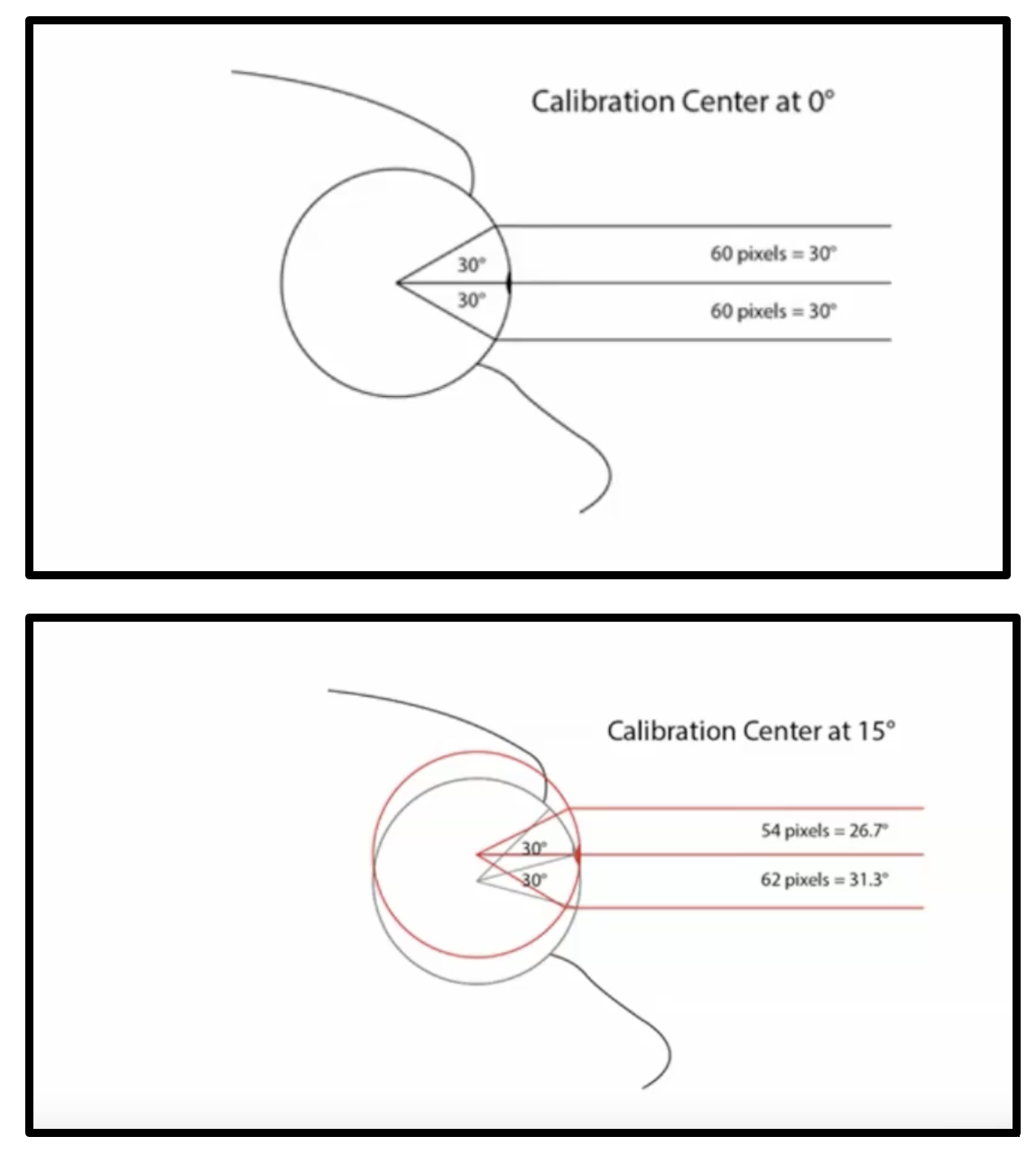
A set of two geometric diagrams comparing eye calibration. The first shows an ideal scenario with a stable zero-degree reference point and equal 30-degree eye deviations. The second shows a 15-degree off-center head shift where the algorithm's predicted eye position (red) mismatches the actual eye location (gray), resulting in skewed eye angle reports.

Figure 1: Ideal vs. Off-Center Calibration Geometry

The clinical challenge arises from the sensitivity of this mathematical model to head stability. Earth-fixed targets, including wall-mounted monitors and light bars, are linked to stationary objects in the room. In this configuration, even small, unintended head movements introduce measurement errors because the system's assumption regarding the distance to the target no longer matches reality. For instance, a minor head shift of 15 degrees can cause an asymmetry of about 8% in the reported angle, potentially leading to the misinterpretation of vestibular data. This is particularly problematic in balance clinics, as pathological patients are often more inclined to move their head rather than their eyes to avoid retinal slip and maintain a sense of security.

Head-mounted targets offer a more robust alternative by projecting the visual stimuli from a reference surface attached to the patient's head. Because the stimulus moves with the head, the relative geometry between the eye and the target remains consistent even if the patient fidgets or shifts position. Any head movement simultaneously shifts the zero reference point, preventing data errors from pulling through the VNG results. This adaptability is critical in real-world clinical environments where perfect head stability is difficult to maintain, ensuring high-quality eye traces during saccade and smooth pursuit testing without the need for physical head clamping or repetitive testing due to movement artifacts.

A chart displaying saccade and smooth pursuit eye traces in two columns. The left column (World-Referenced) shows significant misalignment and offsets between the target and eye traces when the head moves by 3 degrees or tilts. The right column (Head-Referenced) shows the eye traces remaining perfectly aligned with the target traces despite identical head movements, demonstrating the system's robustness to motion.

Figure 2: Comparative Traces for World-Referenced vs. Head-Referenced Targets


To learn more and earn continuing education credits, register for the live CEU event: ICS Dizcovery VNG: Navigating Precision in Eye-Tracking.


stacy morrow

Stacy Morrow

Stacy is Senior Director of Product Management at Natus Sensory. She has over 15 years of experience in vestibular diagnostics, with her career experience as an audiological scientist and clinical lead for national health services in places like Manchester and Birmingham, UK. She has been the author and co-author of several white papers, including her latest collaboration with Prof. Hamish MacDougall in Australia.


Related Courses

ICS Dizcovery VNG: Navigating Precision in Eye-Tracking
Presented by Stacy Morrow
Recorded Webinar
Natus Sensory

Presenter

Stacy Morrow
Course: #41070Level: Advanced1 Hour
  'The overview of how calibration values are obtained was really good'   Read Reviews
Video-based eye tracking is a powerful tool for evaluating eye movements in clinical practice. This course explores the mathematical principles underpinning eye-tracking calibration and addresses the challenges associated with head movements, particularly the complexities involved in ensuring precision when measuring eye-tracking.

View this Course for FREE.
Need CEUs? Become a AudiologyOnline member to get unlimited CEUs.

Only $129/yr

Learn More

A Guide to Bithermal Caloric Testing
Presented by Amanda Cerka Mroz, AuD, FAAA, CCC-A
Recorded Webinar
Natus Sensory

Presenter

Amanda Cerka Mroz, AuD, FAAA, CCC-A
Course: #815Level: Intermediate1 Hour
  'Very concise and clear'   Read Reviews
No CEUs/Hours Offered
The purpose of this course is to provide an in-depth discussion of the caloric testing portion of the VNG/ENG test battery. Content will include descriptions of testing procedures, analysis and interpretation of results.

View this Course for FREE.
Need CEUs? Become a AudiologyOnline member to get unlimited CEUs.

Only $129/yr

Learn More

ICS Impulse – Revolutionizing Vestibular Assessment
Presented by Wendy Crumley-Welsh, MS, CCC-A
Recorded Webinar
Natus Sensory

Presenter

Wendy Crumley-Welsh, MS, CCC-A
Course: #22641Level: Intermediate1 Hour
  'very detailed explanation'   Read Reviews
No CEUs/Hours Offered
ICS Impulse makes head impulse testing accessible for any clinician. This course will cover what is gained by performing the head impulse, how to perform the head impulse, and how does the data obtained assist in the diagnosis and treatment of the patient and how does it fit into our current battery of tests.

View this Course for FREE.
Need CEUs? Become a AudiologyOnline member to get unlimited CEUs.

Only $129/yr

Learn More

A Guide to Bithermal Caloric Testing
Presented by Amanda Cerka Mroz, AuD, FAAA, CCC-A
Recorded Webinar
Natus Sensory

Presenter

Amanda Cerka Mroz, AuD, FAAA, CCC-A
Course: #36752Level: Intermediate1 Hour
  'great info on DP and gain asymmetry'   Read Reviews
The purpose of this course is to provide an in-depth discussion of the caloric testing portion of the VNG/ENG test battery. Content will include descriptions of testing procedures, analysis and interpretation of results.

View this Course for FREE.
Need CEUs? Become a AudiologyOnline member to get unlimited CEUs.

Only $129/yr

Learn More

Quick Guide to VNG Interpretation
Presented by Amanda Cerka Mroz, AuD, FAAA, CCC-A
Recorded Webinar
Natus Sensory

Presenter

Amanda Cerka Mroz, AuD, FAAA, CCC-A
Course: #36813Level: Intermediate1 Hour
  'nice review of VNG results and analysis (anatomy & test procedures are not really covered)'   Read Reviews
The purpose of this course is to describe the VNG test battery in the context of the anatomy and physiology of the balance system. Examples of common VNG abnormalities will be shown.

View this Course for FREE.
Need CEUs? Become a AudiologyOnline member to get unlimited CEUs.

Only $129/yr

Learn More