

Oticon Medical
 

What is the Difference Between a Foam Tip and an Earmold RECD?

Julie Purdy, PhD, Sheila T. Moodie, PhD, MCISc

March 24, 2008


Question

What is the difference between a foam tip and an earmold RECD?

Answer

The main difference will be noted in the high-frequency region. An RECD measured with a foam tip will show a reduction in values starting around 3 or 4 kHz. When an earmold from a toddler or adult is used in place of a standard foam tip, the increased length of tubing on the earmold will cause a reduction in RECD values around 2 kHz (see Figure 1). This change in values may not be present when measuring with a young infant's earmold as the tubing may be the same length as a standard foam eartip.
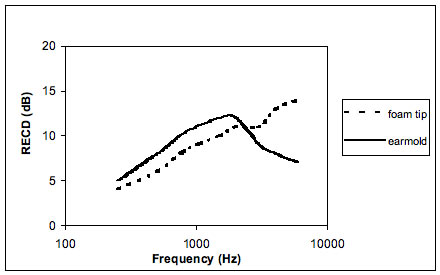

Figure 1. Comparison of RECD values when using a foam tip versus a custom earmold. Note the high-frequency difference in values.


It is important to be able to distinguish that the change in high-frequency values is due to increased tubing length and not shallow probe tube insertion. However, if the clinician used the customized probe tube insertion depth strategy outlined previously (Figure 2), then a roll-off in high-frequency values will likely be due to increased tubing length from the earmold.

This Ask The Expert Question was taken from an article previous published on Audiology Online entitled, "Learning the Art to Apply the Science: Common Questions Related to Pediatric Hearing Instrument Fitting". See Bagatto and Moodie (2007) for additional information.

References

Bagatto, M., Moodie, S., (2007, October 8). Learning the Art to Apply the Science: Common Questions Related to Pediatric Hearing Instrument Fitting. Audiology Online, Article 1886. Accessed from the Article Archives from www.audiologyonline.com/articles/article_detail.asp?article_id=1886

Marlene Bagatto, Au.D., is a Research Associate and Sheila T. F. Moodie, M.Cl.Sc., is a Research Audiologist at the National Centre for Audiology at the University of Western Ontario in London, Ontario, Canada.

julie purdy

Julie Purdy, PhD


sheila t moodie

Sheila T. Moodie, PhD, MCISc

Research Audiologist in The Child Amplification Laboratory

Sheila Moodie is a Research Audiologist in The Child Amplification Laboratory, at The National Centre for Audiology, University of Western Ontario and a PhD Candidate in the Health and Rehabilitation Sciences Program, Faculty of Health Sciences also at The University of Western Ontario. She has assisted in the development and methods to improve the clinical implementation of the DSL Method for over 20 years. She has been awarded a Canadian Institutes of Health Research Frederick Banting and Charles Best Canada Graduate Scholarship to study methods that reduce the knowledge utilization gap in audiology by encouraging collaborative linkage and exchange between researchers and clinicians. none


Related Courses

Presenter

Presenter: sheila t moodie

Sheila T. Moodie, PhD, MCISc

20Q: Moving from Evidence to Practice - Can Knowledge Translation and Implementation Science Help Audiology Get There? [Text/Transcript Course]

Course: #19419
CEUs/Hours Offered: AAA/0.1 Intermediate; ACAud/0.1; AHIP/1.0; ASHA/0.1 Intermediate, Professional; BAA/1.0; CAA/1.0; CASLPA/1.0; Calif. HADB/1.0 Hearing Aid Related; IHS/1.0
Cost: Free to View

Everyday clinical practice often falls short of what is recommended in evidenced-based research or best practice guidelines. This article provides an overview of the field of study known as knowledge translation and implementation science, and discusses its potential application to audiology in order to help overcome barriers and facilitate implementation of best practices across the profession.

Presenter

Presenter: sheila t moodie

Sheila T. Moodie, PhD, MCISc

Clinician Fit-to-DSL Targets: Preliminary Results From a Network Study [Recorded Course]

Course: #14898
CEUs/Hours Offered: AAA/0.1 Intermediate; ACAud/0.1; AHIP/1.0; BAA/1.0; CAA/1.0; Calif. HADB/1.0 Hearing Aid Related; IHS/1.0; Kansas DHE, LTS-S0035/1.0
Cost: Free to View

The Desired Sensation Level (DSL) Method is a recommended hearing aid prescriptive method that defines the auditory area based on the unique individual characteristics of the child's ears and then prescribes the frequency/gain characteristics that will provide amplified speech that is audible, comfortable, and undistorted across the broadest relevant frequency range possible. This fit-to-DSL target study aimed to compare the results of real-ear measures of hearing aid performance for a variety of hearing losses collected by clinicians in a pediatric network with the DSL v5.0a prescribed target criteria across frequency and input levels.

Presenters

Presenter: marlene bagatto

Marlene Bagatto, AuD, PhD

Sheila T. Moodie, PhD, MCISc

Frequently Asked Questions About Fitting Hearing Aids to the Pediatric Population [Recorded Course]

Course: #10352
CEUs/Hours Offered: AAA/0.1 Intermediate; ACAud/1.0; AHIP/1.0; BAA/1.0; CAA/1.0; CASLPA/1.0; IHS/1.0; Kansas DHE, LTS-S0035/1.0
Cost: Free to View

Pediatric audiologists rely on evidence-based procedures when fitting hearing aids to their young patients. Although the science is concrete and clinically feasible, there are some practical topics of relevance that may not have been covered in a formal publication. This article aims to address some frequently asked questions related to procedures used for pediatric hearing instrument fitting.

Presenters

Presenter: marlene bagatto

Marlene Bagatto, AuD, PhD

Sheila T. Moodie, PhD, MCISc

Learning the Art to Apply the Science: Common Questions Related to Pediatric Hearing Instrument Fitting [Text/Transcript Course]

Course: #9790
CEUs/Hours Offered: AAA/0.1 Intermediate; ACAud/1.0; BAA/1.0; CAA/1.0; CASLPA/1.0; Calif. HADB/1.0 Hearing Aid Related; IHS/1.0; Kansas DHE, LTS-S0035/1.0
Cost: Free to View

Pediatric audiologists rely on evidence-based procedures when fitting hearing aids to their young patients. Although the science is concrete and clinically feasible, there are some practical topics of relevance that may not have been covered in a formal publication. This article aims to address some frequently asked questions related to procedures used for pediatric hearing instrument fitting.

Presenter

Luis F. Camacho, MA, FAAA

Earmolds: Yes We Do Still Need Them! [Recorded Course]

Course: #16848
CEUs/Hours Offered: AAA/0.1 Intermediate; ACAud/1.0; AHIP/1.0; BAA/1.0; CAA/1.0; CASLPA/1.0; Calif. HADB/1.0 Hearing Aid Related; IHS/1.0; Kansas DHE, LTS-S0035/1.0
Cost: Free to View

This course will provide an overview of basic earmold knowledge. Focus on tubing, venting, attachment options and acoustic modifications will be provided, as well as information on Starkey's pediatric earmolds.