
"Ringing in the ears" is the most common complaint described by people who also suffer from precipitous high frequency sensorineural hearing impairment. In many cases, their tinnitus can be frequency matched to tones of approximately 3-4kHz, as demonstrated by matching techniques involving pure tones delivered by standard clinical audiometers. The purpose of this study was to examine whether the subjective loudness perception of tinnitus increased, as the hearing threshold at 4kHz worsened. To evaluate whether a correlation existed, we examined the audiometric and tinnitus assessment data for 16 hearing impaired subjects, all of whom participated in a larger study on tinnitus and amplification. From our analysis, we found strong correlations between the degree of hearing loss sensitivity at 4kHz and the subjective loudness perception of the tinnitus. This trend was even more pronounced when pure tone thresholds at 4kHz were determined to be greater that 70dB. These findings, particularly when combined with more global information regarding the type and degree of hearing loss, the history and the patient's amplification needs and preferences, might prove valuable in designing tinnitus treatment programs and effective amplification strategies in cases of high frequency loss.
Introduction:
Tinnitus can be defined as "noise perceived in the absence of a known external sound source." The quantity of Americans experiencing tinnitus is upwards of 44 million adults. Of those, approximately 1 million consider themselves significantly debilitated as a result of the condition (American Tinnitus Association, 2000; NIDCD, 2004).
Tinnitus sufferers have subjectively described their tinnitus using a myriad of images and sounds. Among the most common descriptions are; "ringing," "buzzing," "crickets," "locusts," "roaring" and "frying" (Foreman, 2004; Chartrand, 1989). Table 1 (below) shows the percentage of subjects who described their tinnitus using specific descriptors (i.e., ringing - 63%, buzzing -27% etc). These subjects were participants in various studies by the author and their responses were acquired from 1982-1987.
Subjective descriptions of tinnitus have been shown to be associated with various otologic lesions and disorders such as otosclerosis, vascular constrictions, allergy, infection and sensorineural hearing loss (Yoo et al, 1991; Hoover, 1987; Marchiando, Per-Lee, and Jackson, 1983).
Table 1. Subjective descriptions of tinnitus in a population of hearing aid users
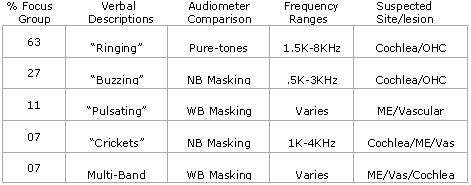
Note: Total is more than 100% because of multiple descriptions
The most common associated complaint from people with sensorineural high frequency hearing loss is tinnitus. Patients with this audiometric profile (sensorineural high frequency hearing loss) generally describe their tinnitus sensation as "ringing." Interestingly, the "ringing" can be "frequency matched" using a traditional audiometer, and is most often determined to be in the 3-4kHz region. This frequency region (3-4kHz) often corresponds with the traditional "noise notch" caused by exposure to industrial and recreational noise (Rabonowitz, 2000).
Of course, not all individuals with sensorineural high frequency hearing loss have tinnitus. However, it is generally accepted that upwards of 80% of those with sensorineural high frequency hearing loss, do indeed, have tinnitus (Vernon, 1996). Of those individuals who experience tinnitus and high frequency hearing loss, not all frequency matches of tinnitus will be determined to be between 3-4kHz. However, of those who exhibited precipitous sensorineural high frequency hearing loss in tandem with complaints of "high pitch ringing," their frequency matching was consistently determined to be in the region of 3-4kHz, the region considered to be the "noise notch" from over-exposure to loud noise (Rabanowitz, 2000).
There are likely many dozens of contributing factors that determine tinnitus susceptibility and tinnitus perception. The list of possible contributing factors is lengthy and beyond the scope of this paper. However, a brief review of these factors would include; type and degree of hearing loss, physical characteristics and abnormalities of the head and neck, personal medical history, personality type, individual stress responses, and a multitude of physiologic, anatomic and psychosocial factors.
Knowing if there is a typical and positive relationship between hearing threshold and perceived loudness of tinnitus can help the hearing health professional assess the situation and provide better amplification strategies to reduce the subjective annoyance of tinnitus. Hearing aid patients who suffer from tinnitus may benefit from one or more of the 4 identified benefits of amplification below (Chartrand, 1993):
Potential Tinnitus-Specific Benefits from Amplification:
- Residual Inhibition (RI)
Since its formation in the early 1970s, the American Tinnitus Association (ATA) has compiled myriad studies and data on virtually every conceivable aspect of tinnitus. Nearly all studies agree that the perception of tinnitus can be as variable and individual as the people experiencing it (Chartrand, 1989).
For individuals with permanent sensorineural high frequency hearing impairment, it has, unfortunately, been generally accepted that either "nothing can be done" (Nagler, 2001) or that hearing aids or masker instruments (or combined hearing aid/maskers) are the probable and only solutions (Chartrand, 2003; Nodar, 2002; Vernon, 1988). Nonetheless, there are many other options to effectively manage tinnitus for the majority of tinnitus patients, most notably -- appropriate amplification for the population of this study.
Tinnitus Retraining Therapy (TRT) has been a very popular tinnitus management technique. An entire body of research and treatment methodology has evolved around Jastreboff's and Hazell's TRT pioneering approach to tinnitus management (Chartrand, 2003). Unlike most other approaches for tinnitus treatment, Tinnitus Retraining Therapy is holistic and encompasses methodology based on a multiple of other tinnitus management techniques, including appropriate fitting of amplification.
Previous methodologies for assessing quantitative and qualitative characteristics of tinnitus have included those devised by Vernon (1964), Jastreboff and Hazell (1987) and Chartrand (1993). Each of these methodologies use common audiometric equipment, case history questionnaires and evaluation procedures to reasonably determine perceptive characteristics (i.e., pitch, loudness and stimulative sound sources such as pure-tone, narrow-band, or pink or white noise masking). These three methodologies typically work best with sensorineural high frequency hearing loss in which tinnitus matching indicates the center frequency of the tinnitus approximates 3-4kHz (Chartrand, 1989/2003).
Purpose:
Previous literature does not indicate how to identify individual perception of tinnitus loudness based on audiometric configurations. Therefore, the purpose of this study was to determine if the audiometric configuration, particularly the degree of hearing loss at 4kHz, was correlated with the self-perceived loudness of tinnitus.
Methods:
Subjects for this study were a subset of those recruited for a larger project. The larger project was titled "Tinnitus & Amplification 2002 Study," and was conducted by this author and colleagues. For Tinnitus & Amplification 2002 Study, subjects were recruited using newspaper advertisements to participate in a study on tinnitus and amplification in the southern region of Colorado during 2002. There were 97 total responses received from 61 males and 36 females. 79 subjects (58 males and 21 females) were accepted into the study after meeting the screening criteria.
The basic four-point screening criteria for participation in Tinnitus 2002 included;
- Subjects must demonstrate a significant degree of permanent, non-medically treatable hearing loss and tinnitus.
- Subjects must provide a detailed history and a list of current medications and supplements.
- Subjects must indicate a willingness to participate according to stated participation activities and timelines.
- Subjects must obtain a referral from their personal physician, along
with reports (if any) relative to their tinnitus complaint.
The three additional (subset) criteria were:
- Subjects exhibit audiometric configurations consistent with normal or near normal low frequency thresholds, with precipitous high frequency hearing loss at 4000 Hz, with thresholds at 4000 Hz determined to be greater than 70 dB HL.
- Tinnitus is pitch-matched at 3-4kHz tone using pure-tone and/or narrow-band soundfield matching techniques (Chartrand, 1993/1994; Vernon, 1964).
- No identifiable "overlay" conditions (ear surgery, ear disease, head trauma, ototoxic medications, systemic illness, etc.) were known or apparent.
- Audiometric puretone threshold at 4kHz (> 70 dB HL).
- Self-rated, tinnitus loudness perception, based on a scale of 1 to 10. For the purpose of this scale, 1 was the softest sound they could hear, and 10 was the loudest sound they could tolerate in everyday listening environments. The scale of loudness perception was transferred into decibels (dB) according to computations shown in Table 2 (below).
Table 2. Scale of Tinnitus Loudness Perception to Decibels above PT Threshold at 4KHz
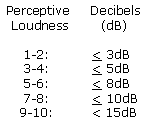
These two variables were plotted, using threshold data as the explanatory variable x, and tinnitus loudness perception as the response variable y (see Table 3) to determine the line of linear regression. From this, we produced the Pearson product-moment correlation coefficient r, and using that data we computed a t score, from which to determine the confidence level C.
Results:
The null hypothesis (Ho) was that the relationship between the threshold @4kHz and the loudness perception of tinnitus is a chance relationship. The alternative hypothesis (Ha) is that there is actually a strong and predictable correlation between the threshold @4kHz and the loudness perception of tinnitus. To express the parameters for expectations of the fore-going hypotheses: Ho: r .40.
For a tabulated view of the subjects in the n=16 group, see Table 3 (below):
Table 3. Table of subject data - Threshold vs Tinnitus Perception
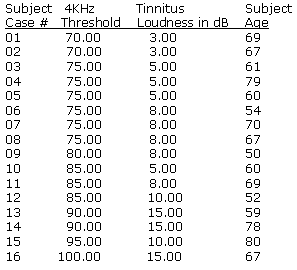
Mean age of subjects was 65 years, median age was 67.0 years. Utilizing the data (above) a scatterplot was created along the horizontal (x) axis and the vertical (y) axis and using least squares and a linear regression line was inserted as follows:
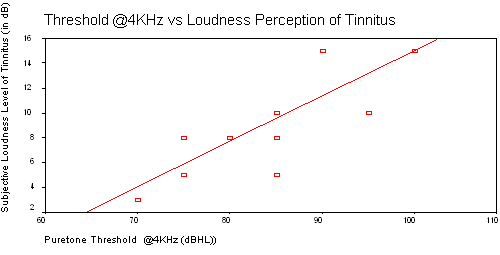
From the data in Figure 1, we find a strong association between severity of puretone threshold @4kHz and patient perception of tinnitus loudness. The Pearson product-moment correlation coefficient of r = .822, with a confidence level t = 5.41 and 99.9% Confidence Level C.
Therefore, we found Ho (the null hypothesis) to be invalid, and Ha (the alternative) accepted, indicating a correlation between the threshold @4kHz and the loudness perception of tinnitus for this subset of subjects.
Discussion:
The author and his colleagues have often noted disengagement between progressive high frequency hearing loss and advancing tinnitus in the minds of patients and clinical professionals. This disengagement often prevents patients from pursuing the more important (and more definitive) work of treating the hearing loss, because of disproportionate awareness of the tinnitus complaint. Consequently, the advantages of amplification cited above (residual inhibition, environmental masking, auditory reattention, and stress relief) often go unrealized.
Hearing health professionals regularly encounter patients who exhibit both a precipitous sensorineural high frequency hearing loss at 4kHz and a tinnitus complaint that matches the 3-4kHz description often described as "ringing in the ears". This study demonstrates evidence that there exists a positive relationship between these two variables. Moreover, it lays out a model for other investigators and clinical professionals to duplicate in the larger population in the hope that such correlation leads to better methodologies in treatment of both the tinnitus and hearing loss.
Although we endeavor to better understand the relationship between self perceived loudness levels of tinnitus and hearing thresholds at 4000 Hz, this study is only a preliminary evaluation, in which findings suggests that a larger and more comprehensive exploration is warranted in the treatment area of tinnitus and amplification.
 Max Stanley Chartrand serves as Director of Research at DigiCare Hearing Research & Rehabilitation, Rye, CO. Correspondence may be sent to www.digicare.org.
References:
American Tinnitus Association, (2004). Home page of the American Tinnitus Assocation, retrieved on October 11, 2004, from www.ata.org/about_tinnitus/.
Andersson, G., Eericksson, J., Lundh, L., and Lyttkens, L., (2000, October). Tinnitus and cognitive interference: A stroop paradigm study. Journal of Speech, Language, and Hearing Research, 43:5, pp. 1168-72.
Chartrand, M.S., (1989, Fall). Tinnitus and Amplification. Audecibel, pp. 18-21.
Chartrand, M.S., (1993, October-December). Tinnitus Management in the Dispensing Practice. Audecibel, pp. 7-10.
Chartrand, M.S., (1994). Inferential Correlates Derived from a Tinnitus and Hearing Impairment Survey Among Hearing Health Professionals. Rye, CO:Aural Rehab Concepts (24 pages).
Chartrand, M.S., (1996). Psycho-Social Principles of Hearing Impairment. In Hearing Instrument Science & Fitting Practices, 2nd edition, Sandlin, R.E., ed, pp. 741-792.
Chartrand, M.S. (2003, March and April). Tinnitus Retraining Therapy and Concepts of Amplification. The Hearing Professional, pp. 7-10.
Foreman, J., (2004, June 29). Q: How can I stop my ears from ringing? S.T., Cambridge. Boston Globe, p. C-2.
Friedenberg, B.M., (2004, March). The effects of progressive muscle relaxation on chronic tinnitus: Results of a controlled treatment study. State University of New York at Albany, Source: DAI-B 64/09, p. 4613.
Hazell, J.W.P., (1987). A cochlear model for tinnitus. Proceedings III International Tinnitus Seminar, Feldmann, ed., Harsch Verlag Karlsruhe, pp. 121-128.
Hoover, S., (1987). Tinnitus and Allergy. Proceedings III International Tinnitus Seminar, Muenster, Germany.
Marchiando, A., Per-Lee, J.H., and Jackson, R.T., (1983). Tinnitus due to idiopathic stapedial muscle spasm. Ear, Nose and Throat Journal, Vol. 62.
Nagler, S.M., (2001). Editorial: The first nail in the coffin. Otology & Neurotology, 22:429, p. 429.
NIDCD, (2004, June 18). The Noise in Your Ears: Facts About Tinnitus. National Institute on Deafness and Other Communication Disorders, retrieved on October 11, 2004, from www.nidcd.nih.gov/health/hearing/noiseinear. asp.
Nodar, R., (2002, March-April). Techniques for Tinnitus Management. The Hearing Professional, pp. 5-8.
Parker, J.F., (2004, October). Post initial neurofeedback experience of functional adults: A qualitative study. Argosy University-Sarasota, Source: DAI-B 65/04, p. 1772.
Rabinowitz, P.M., (2000, May). Noise-Induced Hearing Loss. American Academy of Family Physicians, retrieved on October 11, 2004, from www.aafp.org/afp/20000501/2749.html.
Tinnitus, (2003, December). How is Tinnitus Diagnosed? Your Medical Source, retrieved on October 11, 2004, from yourmedicalsource.com/library/tinnitus/TIN_diagnosis.html.
Vernon, J., (1964). Tinnitus "loudness" as indicated by masking levels with environmental sounds. J. Laryngo. Otol. Suppl, Vol. 9, pp. 59-62.
Vernon, J., (1988). Current use of masking for the relief of tinnitus. Tinnitus, Pathology, and Management, Kitahara, J., ed., pp. 96-106.
Yoo, T.J., Shulman, A., Brummet, R.E., Griest, S.E., Mulkey, M., and Rubenstein, M., (1991). Specific Etiologies of Tinnitus. In Tinnitus: Diagnosis & Treatment, Shulman, Lea, and Febriger (eds.), pp. 342-415.