

Question
PART ONE: Are you aware of any published guidelines or protocols
regarding the closing /sale of an established diagnostic/dispensing
private practice, specifically regarding notification of clients,
maintenance of client records, notification of vendors, insurers etc.?
PART TWO: In the event of practice sale to another audiologist, do HIPAA
regulations preclude the sale of a client list? If not, is there an
established formula for assigning a value to that client list?
I have found numerous resources for business start up (including your excellent response in www.audiologyonline.com "Ask the Experts") but little regarding selling or closing a practice. Any information is appreciated.
Answer
Regarding PART ONE: There are specific rules and regulations that address closing or selling a practice. I recommend that you speak with your attorney for specific instructions, and rules and regulations that apply in your specific state to your situation.
Nonetheless, to the best of my knowledge, the most critical issue is that of "abandonment of the patient." I am not aware on any "laws" on these questions.
The following are AMA policy statements, which would likely be of importance to an audiologist, as well as a physician:
- - - - - - - - -
AMA Policy E-7.04 Sale of a Medical Practice:
A physician or the estate of a deceased physician may sell the elements that comprise his or her practice, such as furniture, fixtures, equipment, office leasehold, and goodwill. In the sale of a medical practice, the purchaser is buying not only furniture and fixtures, but also goodwill, ie, the opportunity to take over the patients of the seller. A patient's records may be necessary to the patient in the future not only for medical care but also for employment, insurance, litigation, matriculation, or other reasons. Therefore, the transfer of records of patients is subject to the following: (1) The physician (or the estate) must ensure that all medical records are transferred to another physician or entity who is held to the same standards of confidentiality and is lawfully permitted to act as custodian of the records. (2) All active patients should be notified that the physician (or the estate) is transferring the practice to another physician or entity who will retain custody of their records and that at their written request, within a reasonable time as specified in the notice, the records (or copies) will be sent to another physician or entity of their choice. (3) A reasonable charge may be made for the cost of locating, duplicating, and mailing records. (IV) Issued July 1983; Updated June 2000.
E-10.01 Fundamental Elements of the Patient-Physician Relationship:
(5) The patient has the right to continuity of health care. The physician has an obligation to cooperate in the coordination of medically indicated care with other health care providers treating the patient. The physician may not discontinue treatment of a patient as long as further treatment is medically indicated, without giving the patient reasonable assistance and sufficient opportunity to make alternative arrangements for care.
E-8.115 Termination of the Physician-Patient Relationship:
Physicians have an obligation to support continuity of care for their patients. While physicians have the option of withdrawing from a case, they cannot do so without giving notice to the patient, the relatives, or responsible friends sufficiently long in advance of withdrawal to permit another medical attendant to be secured.
- - - - - - - - -
Regarding PART TWO of your question "...do HIPAA regulations preclude the sale of a client list....is there an established formula for assigning a value to that client list?"
These types of activities are considered health care operations under HIPAA, and patient information can be shared without specific patient authorizations, as long as both audiologists are covered entities, see below:
45 CFR 164.501 Health care operations means...
(6) Business management and general administrative activities of the entity, including, but not limited to:
(iv) The sale, transfer, merger, or consolidation of all or part of the covered entity with another covered entity, or an entity that following such activity will become a covered entity and due diligence related to such activity...
"We add to the definition of health care operations disclosure of protected health information for due diligence to a covered entity that is a potential successor in interest. This provision includes disclosures pursuant to the sale of a covered entity's business as a going concern, mergers, acquisitions, consolidations, and other similar types of corporate restructuring between covered entities, including a division of a covered entity, and to an entity that is not a covered entity but will become a covered entity if the transfer or sale is completed. Other types of sales of assets, or disclosures to organizations that are not and would not become covered entities, are not included in the definition of health care operations and could only occur if the covered entity obtained valid authorization for such disclosure in accordance with Sec. 164.508, or if the disclosure is otherwise permitted under this rule." (Page 82491 of the commentary on the Privacy rule)
Specifically regarding "...is there an established formula for assigning a value to that client list?"
You cannot sell patient records, it is illegal. You can take over the records under all of the conditions mentioned above, specifically the good will statement mentioned, as long as both audiologists are in accordance with HIPAA regulations.
The number of patient records are often used to determine the monetary amount a buyer would pay for a practice. But under no circumstance should they specify in writing that they are buying or selling the actual patient record.
In years past, I have seen individuals use: $25 to $50 per patient record (if the patient had actually purchased a hearing aid in the past); a percentage of the gross revenue averaged over the past 3 years, or a percentage of the net revenue averaged over a specific time frame. However, not to be flippant, but in general, a practice (like most businesses) is worth whatever you can get someone to pay you for it!
- - - - - - - - -
The following is a structured outline of what happens to the patient record based on a change in the status of the audiologist. These guidelines were written by Don W. Worthington, Ph.D. for use within the Intermountain Health Care (IHC) system. IHC is a non-profit organization that has three divisions, Physician Division, Health Insurance Division and a Hospital Division. The Hospital Division is comprised of 24 hospitals and over 36 clinics.
NOTE: These instructions (below) are graciously offered as a GUIDELINE ONLY, based on Dr. Worthington's experience and knowledge. Specific instructions should be obtained from your legal counsel, in accordance with applicable federal and state, rules and regulations which govern or impact these transactions. ---Dr Douglas L. Beck, Editor.
- - - - - - - - -
Medical Record movement Based on Audiologist Status:
Preface: This policy is intended to provide direction for medical record movement based on change in status.
Policy: When the status of an audiologist changes based upon location, termination, retirement, selling practice or expiration, the following table should be referred to as a guideline for options and procedures in the disposition of the paper medical record. 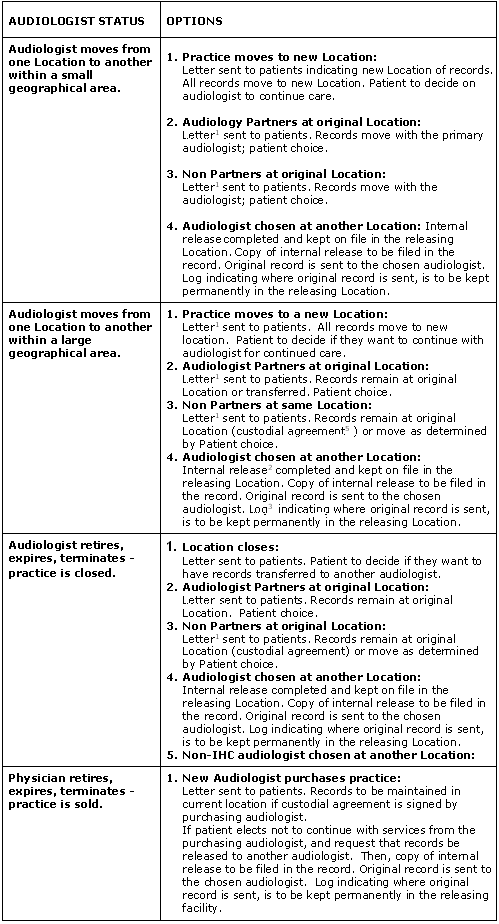
Don W. Worthington, Ph.D., Director
IHC Hearing and Balance Center
230 South 500 East, Suite 150
Salt Lake City, UT 84102
Phone: 801-595-1700
FAX: 801-539-8900
Email: hbdworth@ihc.com
Dr. Don W. Worthington has been an audiologist for over 30 years. He is currently the Director of the IHC Hearing and Balance Center which is located in Salt Lake City, Utah. He loves the field of Audiology.
Note: In the above information, all of the references with E are from the AMA Code of Medical Ethics (https://www.ama-assn.org/ama/pub/category/2503.html)
Those with CFR are for the Code of Federal Regulations, Title 42: Public Health, Part 420 Program Integrity: Medicare, Subpart C - Disclosure of Ownership and Control Information. Part 489 - Provider Agreements and Supplier Approval, Subpart A - General Provisions. Part 455 - Program Integrity: Medicaid, Subpart B - Disclosure of Information by Providers and Fiscal Agents.
Those with an R come from Utah Administrative Code, Title R432 - Health, Health Systems Improvement, Licensing Chapter R432-2 General Licensing Provisions.
The IRS Asset Acquisition Statement:
"Both the seller and buyer of a group of assets that makes up a trade or business must use Form 8594 to report such a sale if goodwill or going concern value attaches, or could attach, to such assets and if the buyer's basis in the assets is determined only by the amount paid for the assets ("applicable asset acquisition," defined below). Form 8594 must also be filed if the buyer or seller is amending an original or a previously filed supplemental Form 8594 because of an increase of decrease in the buyer's cost of the assets or the amount realized by the seller."
View Complete Statement (PDF Format)