
AudiologyOnline Phone: 800-753-2160


NEW! Stream big with MED-EL Sonnet 3 and Audiolink XT. Learn more button

Why Are Hearing Aids So Expensive?

Amyn Amlani, PhD

April 23, 2007

Share:

Question

When many of my patients frequently ask, "Why are hearing aids so expensive?" I feel that I don't have a good answer for them. So why are hearing aids expensive?

Answer

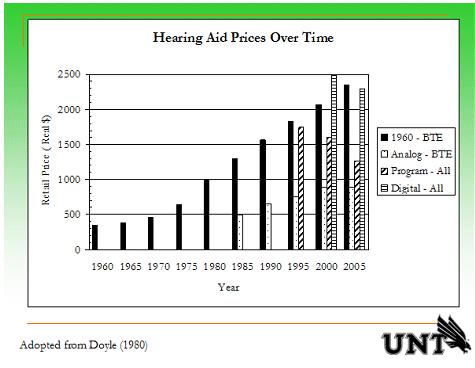
When we look at the increase in hearing aid prices attributable to inflation from 1960 to 2005, we actually see that hearing aids are comparatively less expensive today than they were in the 1960s. The following graph, adapted from Doyle (2005), shows the trend of hearing aid prices over time. An analog BTE in the 1960s with a single frequency response, omni directional microphone, and a possible trim pot sold for $350 retail. The same hearing aid when adjusted for inflation would cost about $2,400 in 2005.

In 1985, a similar, more technologically advanced hearing aid (indicated by the white bar) was 1/3 the retail price of the 1960 device adjusted for inflation. Continuing on in 1995, programmable hearing aids, including all styles, cost less than the 1960 hearing aid as well. Lastly, the average price of a digital programmable device in 2005 is less expensive and more advanced than the 1960 HA adjusted for inflation. The bottom line is that the retail price of hearing aids today, which are move advanced than those of the past, are actually slightly less expensive than the rate at which inflation has increased.


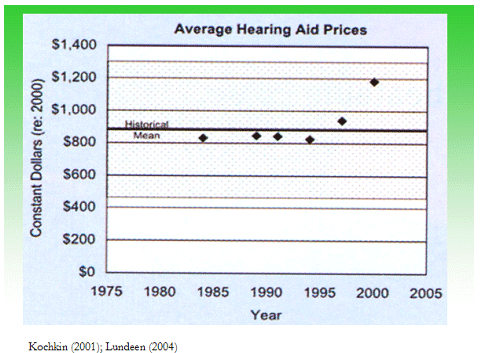
We can also compare modern hearing aid prices to historical values. In the next graph, all hearing aid prices have been adjusted to constant dollars in the year 2000. The horizontal line, "Historical mean," represents the average retail cost of a hearing aid made with carbon, vacuum tubes, and transistor technology between 1905 and 1961; this value is $882. Shaded areas represent one standard deviation above and below the mean. Diamonds signify the average hearing aid price determined in a MarkeTrak VI survey. Despite the fact that hearing aid prices in 1999 and 2000 were higher than the historical mean, each diamond is still within one standard deviation of the mean. Again, what this boils down to is that there is no significant difference in price between modern and historical hearing aids.


Amyn M. Amlani, Ph.D., is an Assistant Professor on the faculty of the Department of Speech and Hearing Sciences, University of North Texas. His research interests include hearing aid fitting and selection procedures, auditory perception in real-world environments, cognitive effects on hearing aid use and benefit, and economic and marketing trends within the hearing aid industry.


Amyn Amlani, PhD

Assistant Professor

Amyn M. Amlani, Ph.D., is an Assistant Professor on the faculty of the Department of Speech and Hearing Sciences, University of North Texas, where he has held an academic appointment since August 2005. He has also held an appointment of Assistant Professor at the Texas Tech University Health Sciences Center from January 2003 through August 2005. Dr. Amlani holds the B.A. degree in Communication Disorders from the University of the Pacific, the M.S. degree in Audiology from Purdue University, and the Ph.D. degree in Audiology from Michigan State University. Dr. Amlani is also a member of several professional organizations, and has authored and co-authored papers related to hearing aids in the American Journal of Audiology, Audiology Today, Journal of the American Academy of Audiology, Journal of Speech-Language-Hearing Research, Trends in Amplification, The Hearing Journal, and Hearing Review. His research interests include hearing aid fitting and selection procedures, auditory perception in real-world environments, cognitive effects on hearing aid use and benefit, and economic and marketing trends within the hearing aid industry.


Related Courses

Understanding Privilege, for Healthcare Professionals
Presented by Esther Clervaud, EdS
Recorded Webinar
AudiologyOnline

Presenter

Esther Clervaud, EdS
Course: #36096Level: Intermediate1 Hour
  'The presenter kept my interest throughout the presentation'   Read Reviews
Systems of privilege have created a wide division of inequality. This course will help hearing care professionals identify their privilege and determine how to make a difference in their places of employment.

View this Course for FREE.
Need CEUs? Become a AudiologyOnline member to get unlimited CEUs.

Only $129/yr

Learn More

Creating Leadership in Audiology Through a Mentoring Circle
Presented by Natalie Phillips, AuD
Recorded Webinar
AudiologyOnline

Presenter

Natalie Phillips, AuD
Course: #37632Level: Introductory1 Hour
  'The presenter was very knowledgeable and comfortable discussing this topic'   Read Reviews
There are so many components to quality patient care that it is challenging to “master” them all. What if you could come together with other professionals who possess knowledge or experience that could help you or your practice? There are a number of veteran audiologists as well as rising professionals who have wisdom, qualifications, narratives, and unique journeys to share. The purpose of this talk is to rethink the traditional mentor/mentee vertical relationship and explore collaboration in the form of circle…where all professionals, regardless of age or experience, learn from each other.

View this Course for FREE.
Need CEUs? Become a AudiologyOnline member to get unlimited CEUs.

Only $129/yr

Learn More

Core Topics for Audiology Assistants
Presented by James W. Hall III, PhD, Kathleen Weissberg, OTD, OTR/L, Amit Gosalia, AuD
Recorded Webinar
AudiologyOnline

Presenters

James W. Hall III, PhDKathleen Weissberg, OTD, OTR/LAmit Gosalia, AuD
Course: #37123Level: Introductory3 Hours
  'Great three-part series, thank you!'   Read Reviews
This course includes one hour of content on each of the following topics: 1) ethical concepts and decision-making; 2) universal safety precautions, including the Occupational Safety & Health Administration's (OSHA) bloodborne pathogens standard, and 3) patient confidentiality and the Health Insurance Portability & Accountability Act (HIPAA).

View this Course for FREE.
Need CEUs? Become a AudiologyOnline member to get unlimited CEUs.

Only $129/yr

Learn More

Engaging Deaf Professionals in the EHDI System
Presented by Sheri Farinha, MA, Julie Rems Smario, EdD
Recorded Webinar
AudiologyOnline

Presenters

Sheri Farinha, MAJulie Rems Smario, EdD
Course: #37893Level: Intermediate1 Hour
  'hearing from deaf professionals and their perspective of how they can help through their lived experiences'   Read Reviews
The course explores ways to draw on Deaf professionals' expertise in working with families of Deaf and hard of hearing infants and young children. A highlight of Deaf people's knowledge, experiences, expertise, and contributions in the EHDI (Early Hearing Detection and Intervention) System will be discussed.

View this Course for FREE.
Need CEUs? Become a AudiologyOnline member to get unlimited CEUs.

Only $129/yr

Learn More

Innovative Audiologic Care Delivery
Presented by Rachel Magann Faivre, AuD, Lori Zitelli, AuD, Heather Malyuk, AuD, Ben Thompson, AuD
Recorded Webinar
AudiologyOnline

Presenters

Rachel Magann Faivre, AuDLori Zitelli, AuDHeather Malyuk, AuDBen Thompson, AuD
Course: #38661Level: Intermediate4 Hours
  'Great content and some new information'   Read Reviews
This four-course series highlights the next generation of audiology innovators and their pioneering approaches to meeting unmet audiologic needs in their communities and beyond. This peer-to-peer educational series highlights researchers, clinicians, and business owners and their pioneering ideas, care delivery models, and technologies which provide desperately needed niche services and audiologic care.

View this Course for FREE.
Need CEUs? Become a AudiologyOnline member to get unlimited CEUs.

Only $129/yr

Learn More

Our site uses cookies to improve your experience. By using our site, you agree to our Privacy Policy.