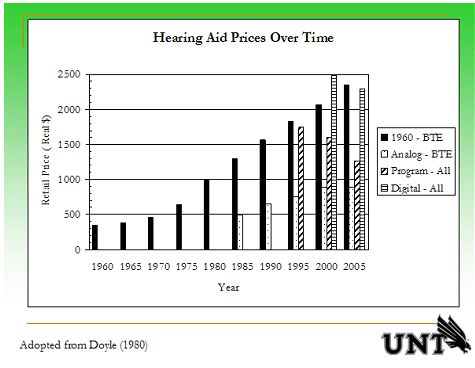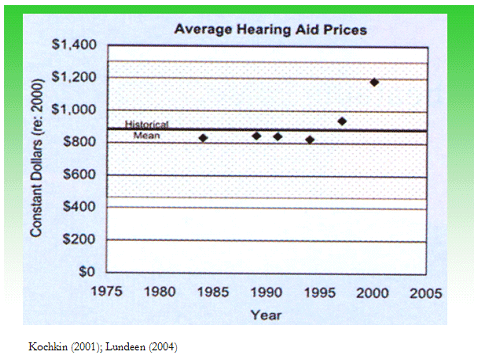
Ask the Experts | Practice Management & Professional Issues | Why Are Hearing Aids So Expensive? Why Are Hearing Aids So Expensive? Amyn Amlani, PhD April 23, 2007 Print Question When many of my patients frequently ask, "Why are hearing aids so expensive?" I feel that I don't have a good answer for them. So why are hearing aids expensive? Answer When we look at the increase in hearing aid prices attributable to inflation from 1960 to 2005, we actually see that hearing aids are comparatively less expensive today than they were in the 1960s. The following graph, adapted from Doyle (2005), shows the trend of hearing aid prices over time. An analog BTE in the 1960s with a single frequency response, omni directional microphone, and a possible trim pot sold for $350 retail. The same hearing aid when adjusted for inflation would cost about $2,400 in 2005.In 1985, a similar, more technologically advanced hearing aid (indicated by the white bar) was 1/3 the retail price of the 1960 device adjusted for inflation. Continuing on in 1995, programmable hearing aids, including all styles, cost less than the 1960 hearing aid as well. Lastly, the average price of a digital programmable device in 2005 is less expensive and more advanced than the 1960 HA adjusted for inflation. The bottom line is that the retail price of hearing aids today, which are move advanced than those of the past, are actually slightly less expensive than the rate at which inflation has increased. We can also compare modern hearing aid prices to historical values. In the next graph, all hearing aid prices have been adjusted to constant dollars in the year 2000. The horizontal line, "Historical mean," represents the average retail cost of a hearing aid made with carbon, vacuum tubes, and transistor technology between 1905 and 1961; this value is $882. Shaded areas represent one standard deviation above and below the mean. Diamonds signify the average hearing aid price determined in a MarkeTrak VI survey. Despite the fact that hearing aid prices in 1999 and 2000 were higher than the historical mean, each diamond is still within one standard deviation of the mean. Again, what this boils down to is that there is no significant difference in price between modern and historical hearing aids. Amyn M. Amlani, Ph.D., is an Assistant Professor on the faculty of the Department of Speech and Hearing Sciences, University of North Texas. His research interests include hearing aid fitting and selection procedures, auditory perception in real-world environments, cognitive effects on hearing aid use and benefit, and economic and marketing trends within the hearing aid industry. Amyn Amlani, PhD Assistant Professor Amyn M. Amlani, Ph.D., is an Assistant Professor on the faculty of the Department of Speech and Hearing Sciences, University of North Texas, where he has held an academic appointment since August 2005. He has also held an appointment of Assistant Professor at the Texas Tech University Health Sciences Center from January 2003 through August 2005. Dr. Amlani holds the B.A. degree in Communication Disorders from the University of the Pacific, the M.S. degree in Audiology from Purdue University, and the Ph.D. degree in Audiology from Michigan State University. Dr. Amlani is also a member of several professional organizations, and has authored and co-authored papers related to hearing aids in the American Journal of Audiology, Audiology Today, Journal of the American Academy of Audiology, Journal of Speech-Language-Hearing Research, Trends in Amplification, The Hearing Journal, and Hearing Review. His research interests include hearing aid fitting and selection procedures, auditory perception in real-world environments, cognitive effects on hearing aid use and benefit, and economic and marketing trends within the hearing aid industry. Related Courses Presenter Kim Cavitt, AuD Unitron PD Series: Practical Solutions to the Most Common Coding and Reimbursement Questions [Recorded Course] Course: #19862 CEUs/Hours Offered: AAA/0.1 Intermediate; ACAud/0.1; BAA/1.0; CAA/1.0; IHS/1.0 Cost: Free to View This presentation will address the most common coding and reimbursement issues facing audiologists today and the questions that result from these issues and situations. We discuss changes for 2012, ICD10, hearing aids in the managed care arena, Medicare regulations and compliance, Medicaid, the need for Advanced Beneficiary Notices, Evaluation and Management coding and the appropriate use of modifiers. Course Details Presenters Michael Valente, PhD Kristi Oeding Expert Series from Siemens: Using Evidence Based Principles to Make Decisions About Amplification [Recorded Course] Course: #18653 CEUs/Hours Offered: AAA/0.1 Intermediate; ACAud/0.1; AHIP/1.0; BAA/1.0; CAA/1.0; CASLPA/1.0; Calif. HADB/1.0 Hearing Aid Related; IHS/1.0; Kansas DHE, LTS-S0035/1.0 Cost: Free to View This presentation will provide a brief overview of Evidence Based Principles and its potential role in shaping the clinical practice for audiologists. The presentation will provide a concrete example of how audiologists can answer the question "Do directional microphones provide additional benefit for my patients when fit with open-ear hearing aids?". The presentation will demonstrate the results of a web search of the appropriate literature and a critical appraisal of the literature. Finally, a power analysis, Cohen's d and 95% confidence interval of the difference between means will be demonstrated on one study to illustrate how "simple" it is for clinical audiologists to critically assess the results of a study to determine if the findings are sufficient to implement the treatment for their patients. Course Details Presenter David J. Smriga, MA Changing Consumer Behavior: the Realities of Audiology-centered Marketing [Text/Transcript Course] Course: #16478 CEUs/Hours Offered: AAA/0.1 Intermediate; ACAud/1.0; BAA/1.0; CAA/1.0; IHS/1.0 Cost: Free to View In order for audiology to be effectively marketed, a fundamental shift in consumer thinking needs to occur. Instead of thinking, "I have a hearing loss, I need to get hearing aids", consumers need to be thinking "I have hearing loss, I need to see an audiologist". This article makes the case for how audiologists can achieve this shift in consumer thinking. Course Details What is Important to Audiologists and Their Individual Decision Choice when Dispensing a Hearing Aid Brand? [Text/Transcript Course] Course: #12330 CEUs/Hours Offered: AAA/0.1 Intermediate; ACAud/1.0; AHIP/1.0; BAA/1.0; CAA/1.0; CASLPA/1.0; Calif. HADB/1.0 Hearing Aid Related; IHS/1.0 Cost: Free to View This article/presentation reports on the factors of varied importance to audiologists when they make an individualized brand preference decision regarding from whom they will dispense the majority of their hearing aids. In addition, methodologies for assessing and reporting how audiologists differentiate hearing aid brands are also presented. Course Details Presenter Michael Valente, PhD Integrating Evidence Based Principles (EBP) to Provide Best Practice for Your Patients [Recorded Course] Course: #14567 CEUs/Hours Offered: AAA/0.1 Intermediate; ACAud/0.1; AHIP/1.0; BAA/1.0; CAA/1.0; Calif. HADB/1.0 Hearing Aid Related; IHS/1.0; Kansas DHE, LTS-S0035/1.0 Cost: Free to View This presentation will provide a brief overview of Evidence Based Principles and their potential role in shaping clinical practice for audiologists. The presentation will provide a concrete example of how audiologists can answer the question "Do directional microphones provide additional benefit for my patients when fit with open-ear hearing aids." The presentation will demonstrate the results of a web search of the appropriate literature and a critical appraisal of the literature. Finally, a power analysis, Cohen's d and 95% confidence interval of the difference between means will be demonstrated on one study to illustrate how "simple" it is for clinical audiologists to critically assess the results of a study to determine if the findings are sufficient to implement the treatment for their patients (recorded 09/30/2009). Course Details